
What Are Biodegradable Urns Made Of? Every Part Explained
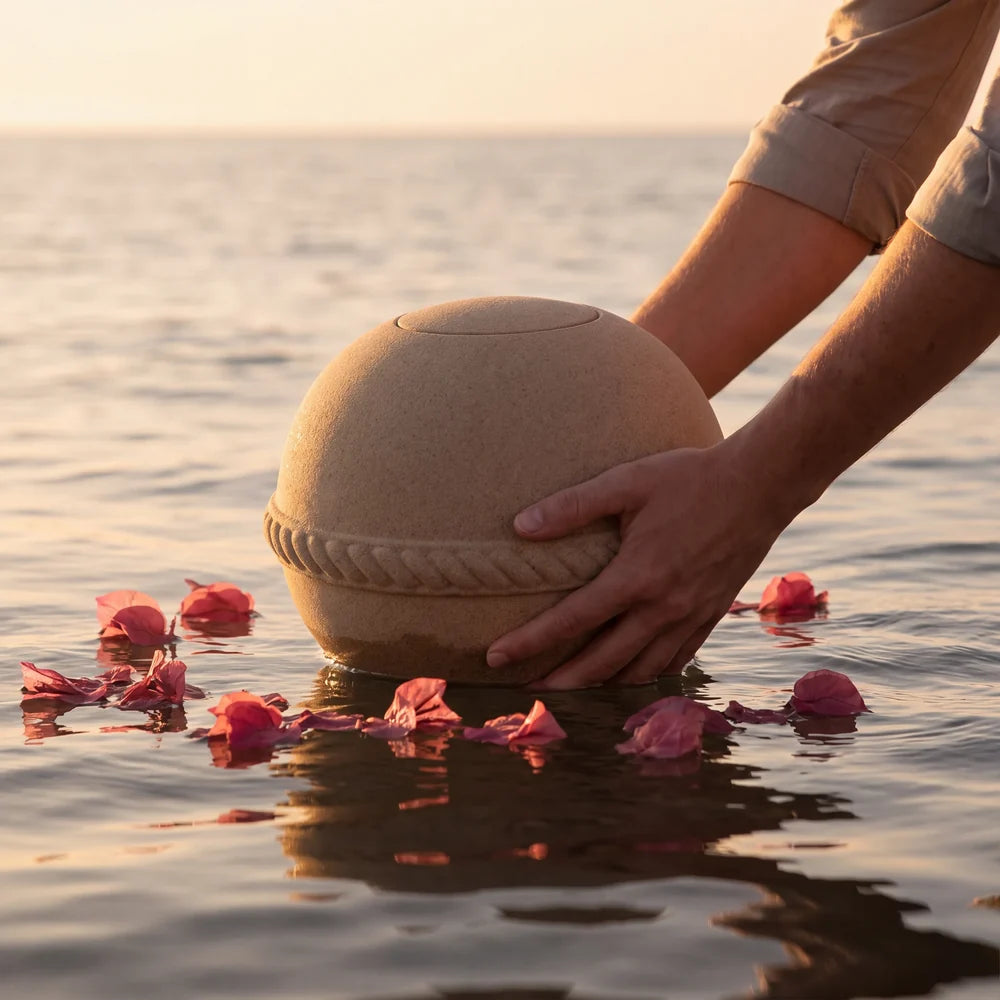
Quick answer: What are biodegradable urns made of? Natural materials that break down in soil or in water: mulberry tree bark, paper, sand with natural gelatin, rock salt, olive stones, bamboo, cornstarch and mycelium. The material decides where the urn can be used, so choose the place first and the material second.
A biodegradable urn holds the ashes safely for the ceremony and then returns to the earth or the water. With this kind of urn the material is not only a matter of looks. It decides whether the urn belongs in the ground, on the water, or on a shelf at home for a while first. This guide goes through the materials one at a time, using biodegradable urns we have at the moment as examples. Every material and size below comes from the page for that urn.
What makes an urn biodegradable?
An urn is biodegradable when every part of it breaks down naturally: the body, the lid, the finish, whatever holds it closed and the bag inside. One plastic liner or metal fitting is enough to leave something behind.
Two things are worth checking on any product page. The first is what the urn is made from, in plain words. The second is where it is meant to go, because an urn made for the ground is not always suitable for water. Several of the urns below have a certificate of biodegradability that can be viewed on their pages.
Mulberry tree bark
Mulberry bark is the material behind many burial urns. The bark is harvested in a way that leaves the tree alive and growing, and the urn is made from it by hand.
The EarthUrn Chest Biodegradable Urn in Antique Brown is made this way. It is a low chest shape with a weathered brown finish that its page describes as closer to old leather than polished wood. It holds 3.28 liters (about 200 cubic inches), listed as suitable for an adult up to approximately 90 kg (198 lb), and weighs 0.7 kg (1.5 lb) empty. The lid lifts off. A line of non-toxic paper glue along the join is optional, and the glue is not supplied. It is made for burial in the ground.

Pictured: EarthUrn Chest Biodegradable Urn for Ashes in Antique Brown - Adult
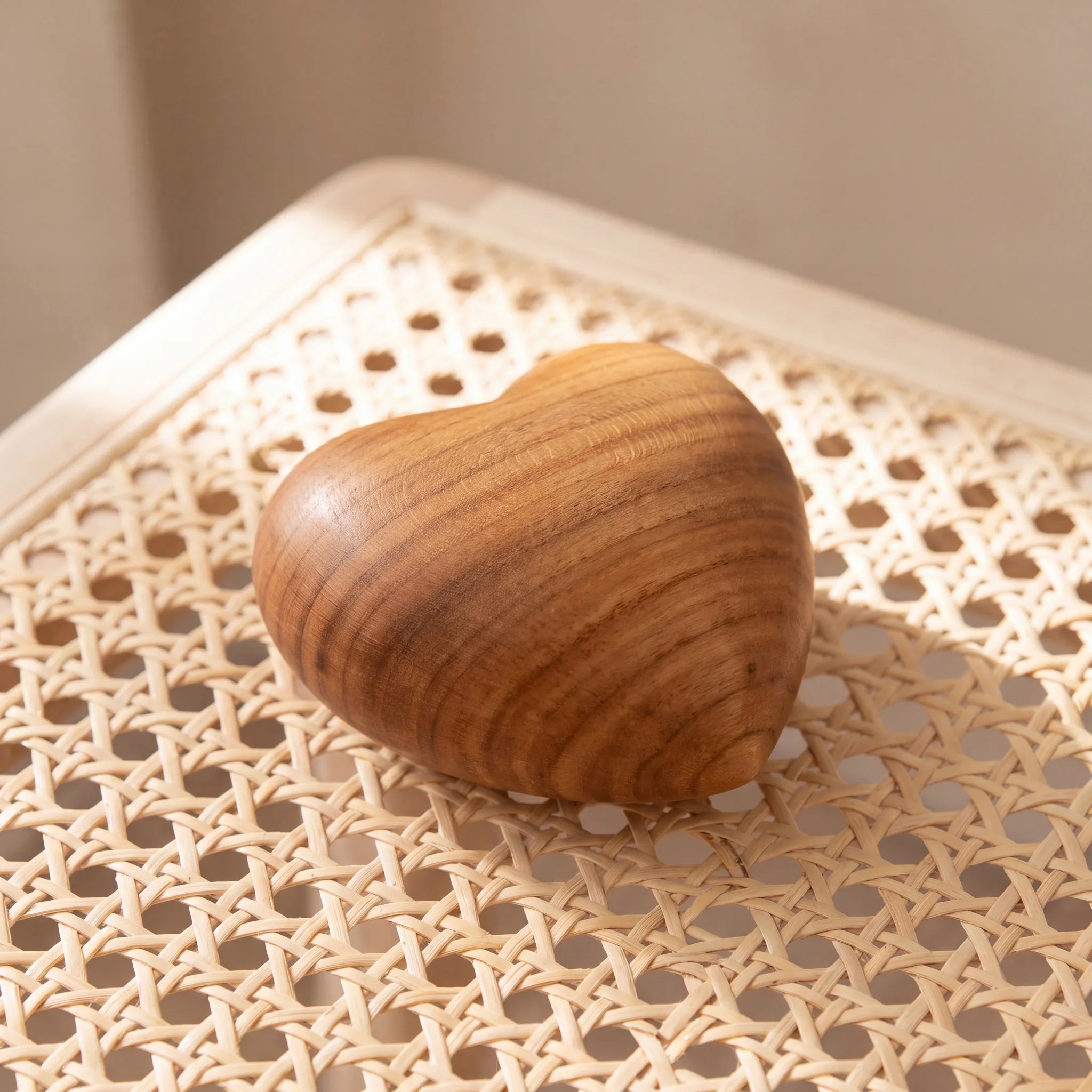
Mulberry bark can be formed into other shapes too. The Love Heart Biodegradable Urn in Wood-Grain is a heart-shaped urn made by hand from the same bark, also holding 3.28 liters (about 200 cubic inches) and also made for burial in the ground.
Paper
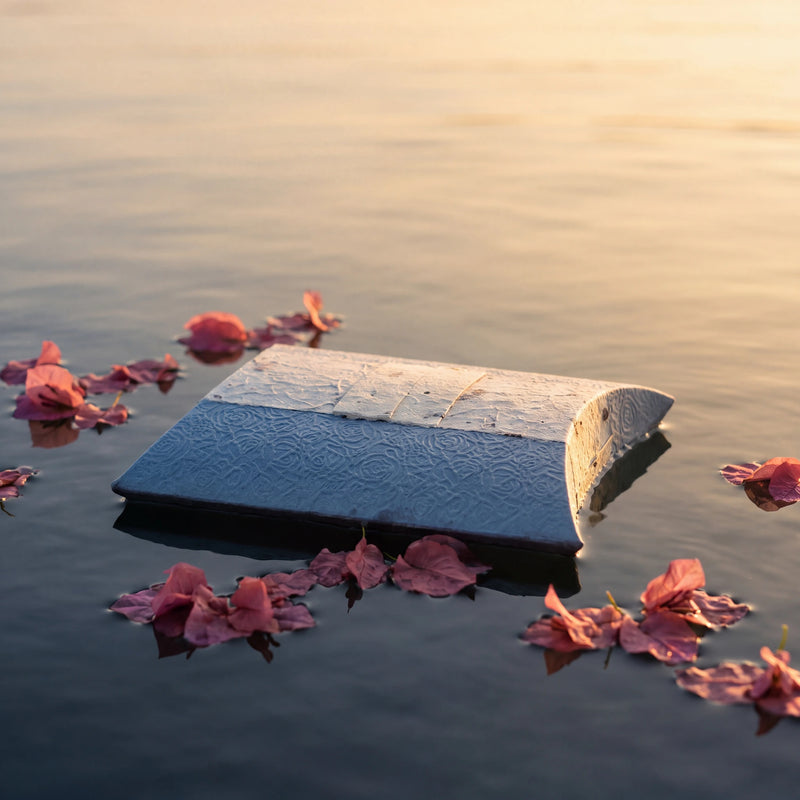
Paper is a common choice for a farewell on water. The Pillow Biodegradable Water Urn in Natural Fibre Paper is made from recycled organic paper created from mulberry tree bark, with fibers from banana leaves that show in the surface. So mulberry bark appears twice in this guide: as a bark urn for the ground and as paper for the water. The pulp is applied by hand to frames and dried in the sun. The urn is a wide, low shape, 10 cm (3.94 in) high and 28.5 cm (11.22 in) across. It holds 4 liters (about 244 cubic inches), weighs 0.2 kg (0.44 lb) empty, and comes with a bio bag for the ashes. Its page says it begins to decompose on contact with water, and that how quickly depends on conditions such as temperature and the movement of the water.

Pictured: Pillow Biodegradable Natural Fibre Paper Water Urn for Ashes - Adult
Paper is also what our scattering tubes are made from: recycled paper with no metal or plastic parts. A tube is for releasing loose ashes by hand, though. It is not placed in the water or the ground with the ashes inside. You can see them in our scatter tubes for ashes.
Plant-based water urns that float, then sink
Not every product page names a single raw material. The Journey Biodegradable Water Urn in Embossed Fern is described on its page as crafted from plant-based material that is safe for open water, without saying which plant. What the page does explain is how it behaves. Placed on the surface, it floats briefly, takes on water, sinks and breaks down naturally over time.
It is a slim, flat shape, 31.5 cm (12.4 in) high and 35.5 cm (14.0 in) wide but only 7.5 cm (3.0 in) deep, in sage green with a raised fern pattern. It holds 3.61 liters (about 220 cubic inches), listed as suitable for an adult up to approximately 99 kg (218 lb), and weighs 0.23 kg (0.5 lb) empty. The ashes go into the biodegradable bag supplied, and the lid closes without glue.

Pictured: Journey Biodegradable Water Urn for Ashes in Embossed Fern - Adult
Sand and natural gelatin
Some water urns look and feel like stone or pottery, yet dissolve. The Oceane Sand Biodegradable Water Urn is formed from a blend of sand and natural gelatin, and its surface is finished with real beach sand. Small holes in the base let water in, so it floats only briefly before it sinks and breaks down. It holds 3.28 liters (about 200 cubic inches), listed as suitable for an adult up to approximately 90 kg (198 lb), and weighs 1.2 kg (2.6 lb) empty. The ashes go inside in the biodegradable bag supplied, and the lid closes without glue.

Pictured: Oceane Sand Biodegradable Water Urn for Ashes - Adult
Rock salt
Salt is a mineral, so it dissolves in water instead of rotting. The Himalayan Rock Salt Biodegradable Water Urn is carved by hand from natural rock salt and left undyed, so each one has its own coloring. It holds 3.31 liters (about 202 cubic inches), listed as suitable for an adult up to approximately 91 kg (200 lb), and weighs 2.42 kg (5.3 lb) empty. Its page says it dissolves fully in water within about four hours, and that it suits display in the home before use. The ashes go inside in the biodegradable bag provided, and it needs no glue to close.

Pictured: Himalayan Rock Salt Biodegradable Water Urn for Ashes - Adult
Olive stones, sand and vegetable materials
Two urns here are made from mineral and vegetable raw materials, and both are listed for the ground and for water.
The Ólea Biodegradable Urn is made from olive stones bound together with plant-based extracts. It is a rounded urn with a textured green surface and a band of natural rope around the middle. It holds 3 liters (about 183 cubic inches) and weighs 1.8 kg (3.97 lb) empty. The lid lifts from the top, and a biodegradable inner bag with a closure tie is included.

Pictured: Ólea Biodegradable Urn for Ashes - Adult
The Arenae Biodegradable Urn is handmade from a blend of sand and vegetable materials, with a matte, grainy surface. It also holds 3 liters (about 183 cubic inches), and weighs 2.7 kg (6.0 lb) empty. Its page says it breaks down over 4 to 8 weeks in the ground, and dissolves in approximately 20 minutes when cast into the ocean. A biodegradable ashes bag with a closure tie is included.

Pictured: Arenae Biodegradable Urn for Ashes - Adult
Mycelium
Mycelium is the root-like part of a fungus, and it can be grown into a shape instead of being molded or carved. The Mycelium Biodegradable Urn is made from mycelium, using material left over from mushroom growing, combined with reused sawdust. It is a plain cylinder with a flat lid and a pale surface that looks a little like stone. It holds 4 liters (about 244 cubic inches) and weighs 0.8 kg (1.8 lb) empty. The lid is removable, and the ashes are placed directly inside. It is made for burial in the ground.

Pictured: Mycelium Biodegradable Urn for Ashes - Adult
Bamboo
Bamboo is a fast-growing grass with a grain like wood. The Eco Burial Bamboo Biodegradable Urn is a plain cylinder made entirely from bamboo, with the grain running up the sides and a removable lid. It holds 3.1 liters (about 189 cubic inches) and weighs 0.3 kg (0.66 lb) empty. Its page says bamboo is strong enough for the urn to be kept safely at home before burial, which helps a family that is not ready to set a date.

Pictured: Eco Burial Bamboo Biodegradable Urn for Ashes - Adult
Cornstarch
Cornstarch is a plant-based material that can be formed into a smooth, solid shape. The Cornstarch EcoUrn in Terracotta is made from it, with no synthetic coatings or plastic parts. It is an extra large urn that holds 5.51 liters (about 336 cubic inches), listed as suitable for an adult up to approximately 152 kg (335 lb), and weighs 0.8 kg (1.8 lb) empty. A biodegradable inner bag is included, and the lid needs no glue. It is made for burial in the ground.

Pictured: Cornstarch EcoUrn Biodegradable Urn for Ashes in Terracotta - Extra Large
The color and the pattern
A finish is part of the urn, so it matters what is on the surface. The simplest answer is nothing at all. The Journey Biodegradable Water Urn in Natural is left in an undyed tone with a subtle woven texture and no added color. It holds 3.61 liters (about 220 cubic inches) and weighs 0.23 kg (0.5 lb) empty. Its page describes it as a biodegradable material designed for water and does not name the material more exactly than that, though a certificate of biodegradability can be viewed there.

Pictured: Journey Biodegradable Water Urn for Ashes in Natural - Adult
Other urns do carry color. The Simplicity Earthurn above has a printed timber pattern, and the Oceane urn is hand-painted and finished with real crushed quartz. If a colored or patterned urn is going to a natural burial ground with strict rules, look for the certificate of biodegradability on the product page, and show it to the ground if they ask.
The closure
This is the part people forget. A metal screw, a plastic clip or a line of ordinary household glue would all stay behind.
The bark urns for burial have a lid that simply lifts off and presses back on. Their pages say a line of non-toxic paper glue can be run around the rim for extra security, that it is optional, and that the glue is not supplied. The water urns need no glue at all. The lids of the Journey, Rock Salt and Oceane urns close firmly by themselves, and the two halves of the Shell fold together and are pressed closed along the seam.
The bag inside
Ashes usually come back from the crematory in plastic. The Cremation Association of North America says the cremated remains are transferred to a strong plastic bag and placed in either an urn or a temporary container if the family has not selected an urn yet (CANA, Cremation Process, read on October 11, 2026). If that plastic bag goes into a biodegradable urn, the urn will break down and the bag will not.
So the ashes need to be moved. The Journey, Rock Salt and Oceane urns each come with a biodegradable bag for this. The page for the Shell says to place the biodegradable bag inside the shell and fill it with the ashes. The Reflect Earthurn with Green Silk Bag, a low, wide bark urn that holds 3.44 liters (about 210 cubic inches), comes with a green silk bag that can be used to hold the ashes if you wish. The page for the Simplicity Earthurn does not list a bag, and the ashes go straight into the urn. If moving the ashes yourself feels like too much, you can ask a funeral director to do it for you.
Medallions and nameplates
Some biodegradable urns carry something extra. The Gourd Biodegradable Urn with Bronze Memorial Medallion is a rounded urn made by hand from mulberry bark, with a bronze memorial medallion. It holds 3.61 liters (about 220 cubic inches), weighs 0.88 kg (1.9 lb) empty, and comes with a nameplate and an inner bag.

Pictured: Gourd Biodegradable Urn for Ashes with Bronze Memorial Medallion - Large
The bark will return to the earth. Bronze is a metal, and the page does not say that the medallion breaks down. For a garden or a family plot that may not matter, and some families like the thought of a small marker staying with the ashes. A natural burial ground may see it differently, so mention the medallion when you ask what they accept.
A natural material does not always mean an urn for burial
It is easy to assume that anything made from a plant is meant for the ground. It is not always so. Bamboo and wood are natural, but an urn made from them may have a protective coat, a varnish or a metal fitting, because it was made for a life on a shelf. So read what the page says about where the urn is meant to go, as well as what it is made of. If the page says an urn is for display at home, take it at its word.
The reverse is also true. A biodegradable urn is the wrong choice if the ashes are to stay at home for good or go into a columbarium niche. These urns should be kept dry until they are used, and a water urn in particular is made for one day. Once an urn has been buried or released, the ashes cannot be brought back, so a family that is still undecided may prefer to wait, or to keep a small portion in a keepsake first. Our guide on why choose a biodegradable urn goes through that decision.
The urns in this guide, side by side
- EarthUrn Chest in Antique Brown (mulberry bark): 3.28 liters (200 cubic inches). Lift-off lid, optional paper glue. For burial in the ground.
- Love Heart in Wood-Grain (mulberry bark): 3.28 liters (200 cubic inches). Lift-off lid, optional paper glue. For burial in the ground.
- Pillow in Natural Fibre Paper (paper): 4 liters (244 cubic inches). Ashes go in the bio bag supplied. For water.
- Journey in Embossed Fern (plant-based material): 3.61 liters (220 cubic inches). Lid closes without glue. For water.
- Oceane Sand (sand and gelatin): 3.28 liters (200 cubic inches). Lid closes without glue. For water.
- Himalayan Rock Salt (rock salt): 3.31 liters (202 cubic inches). Lid closes without glue. For water.
- Ólea (olive stones and plant extracts): 3 liters (183 cubic inches). Lid lifts from the top. For water or burial in the ground.
- Arenae (sand and vegetable materials): 3 liters (183 cubic inches). Lid lifts from the top. For burial in the ground or water.
- Mycelium (mycelium and sawdust): 4 liters (244 cubic inches). Removable lid. For burial in the ground.
- Eco Burial Bamboo (bamboo): 3.1 liters (189 cubic inches). Removable lid. For display at home, then burial in the ground.
- Cornstarch EcoUrn in Terracotta (cornstarch): 5.51 liters (336 cubic inches). Lid closes without glue. For burial in the ground.
If you are unsure about capacity, our urn size guide shows how to work it out.
Which material for which place
For open water, look at paper, sand and gelatin, rock salt, or a plant-based water urn. These are made to come apart or dissolve in water. There are more in our water urns for ashes.
For the ground, look at mulberry bark, mycelium, cornstarch or bamboo. There are more in our biodegradable burial urns. Cemeteries and natural burial grounds set their own rules about containers, so ask before you choose.
If the family has not decided between the two, the urns made from olive stones or from sand and vegetable materials are listed for both.
A biodegradable urn is the wrong choice in some situations. If the ashes are to stay at home for good, or to go into a columbarium niche, a metal, ceramic or wooden urn is the better fit. A water urn must be kept dry until the day. And once any of these urns has been buried or placed on water, the ashes cannot be brought back, so a family that is still undecided may prefer to wait. Our guide on why choose a biodegradable urn goes through that decision, and how long biodegradable urns last covers what happens afterward.
Are the ashes themselves biodegradable?
Not in the way the urn is. The Cremation Association of North America says that the bone fragments that remain after cremation are mostly calcium phosphates, with some other minor minerals, and that the average weight of adult cremated remains is between four and six pounds (CANA, Cremation Process, read on October 11, 2026). Ashes are mineral. They do not rot as wood or paper does. They stay in the soil or disperse in the water as the urn around them breaks down.
United States: what may be left in the ocean
In the United States, the Environmental Protection Agency says that cremated remains may be buried in or on ocean waters of any depth, provided this takes place at least three nautical miles from land, and that the EPA must be notified within 30 days afterward (EPA, Burial at Sea, page last updated August 26, 2026, read on October 11, 2026). The same page says that when ashes are buried at sea in a container, the container must not contain plastic of any kind, float, or otherwise contribute to marine debris. That is the material question in one sentence.
The EPA also says that scattering in lakes, rivers and other inland waters is not subject to federal regulation under that law, and that states may have their own rules for inland waters. This is general information, not legal advice. Rules differ in other countries, so check with the authority responsible for the water or the land you have in mind.
Making a biodegradable urn yourself
Some families would like to make the container themselves, and there is nothing unusual in that. The same test applies as for a bought urn: every part has to be a natural material. Check for the things that are easy to miss, such as varnish, paint, tape, staples, a plastic lining or a synthetic ribbon. If the urn is for a burial ground, ask the ground what it accepts before you begin. If it is for water, bear in mind that it is hard to know in advance how something homemade will behave once it is on the water.
Sizes and product details in this guide were checked against our product pages on October 11, 2026.
Frequently asked questions
What are biodegradable urns made of?
Biodegradable urns are made of natural materials that break down in soil or water. The urns in this guide are made from mulberry tree bark, paper, plant-based material, sand and gelatin, rock salt, olive stones, sand and vegetable materials, mycelium, bamboo and cornstarch.
What makes an urn biodegradable?
An urn is biodegradable when every part of it breaks down naturally, including the lid, the finish, the closure and the bag inside. A plastic liner or a metal fitting would be left behind.
Which materials are used for water urns?
Paper, plant-based material, sand with natural gelatin, and rock salt are used for the water urns in this guide. They are made to come apart or dissolve in water.
Which materials are used for urns buried in the ground?
Mulberry tree bark, mycelium, bamboo and cornstarch are used for the burial urns in this guide. Urns made from olive stones, or from sand and vegetable materials, are listed for both the ground and water.
Can a biodegradable urn be kept at home first?
Some can, as long as they stay dry. The pages for the EarthUrn Chest, Pillow, Oceane Sand, Himalayan Rock Salt and Eco Burial Bamboo urns in this guide all describe them as suitable for display at home before the burial or the farewell on water.
Are human ashes biodegradable?
Ashes are mineral, so they do not rot. The Cremation Association of North America describes them as bone fragments that are mostly calcium phosphates, with some other minor minerals.
Biodegradable Urns for Ashes
See all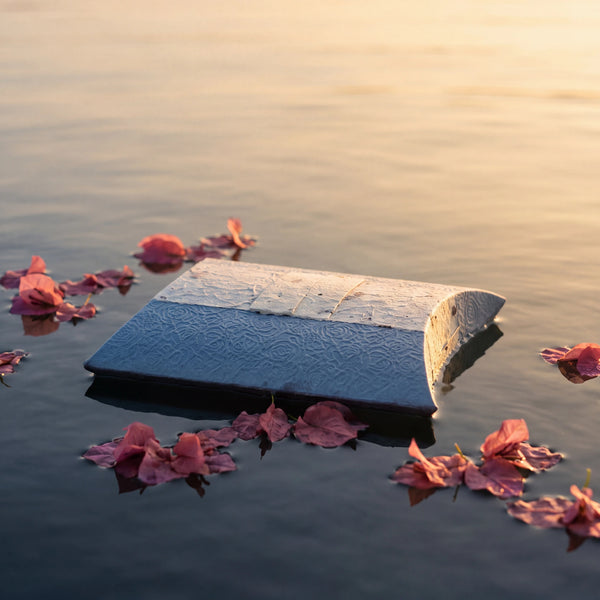 Journey Biodegradable Water Urn for Ashes in Aqua Blossom - Adult
 Embrace Biodegradable Urn for Ashes in White Hemp - Adult
 Pillow Biodegradable Natural Fibre Paper Water Urn for Ashes - Adult
 Simplicity Earthurn Biodegradable Urn for Ashes in Floral - Adult
Written by Urns For Angels
Looking for an urn?
Browse the full range, or ask us and we will help you find the right one.
Keep reading
-
9 min read
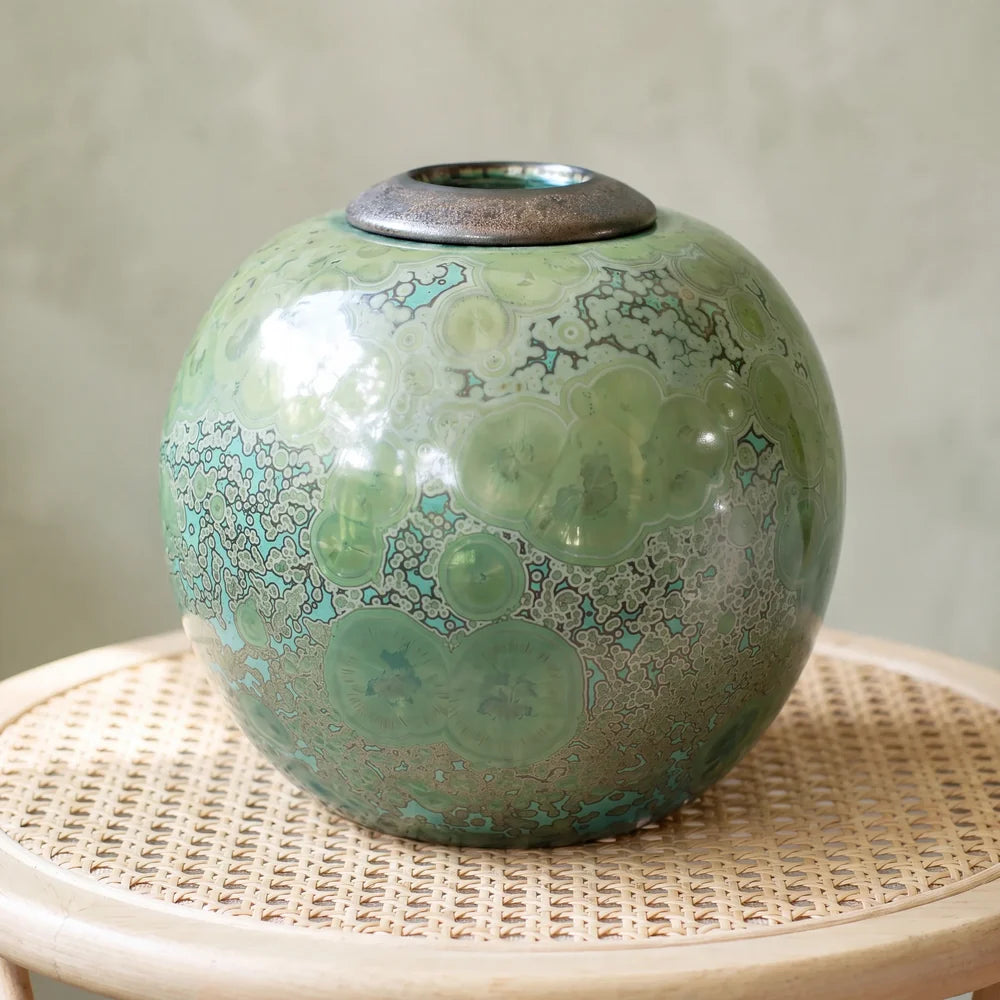
What Are Crystalline Glazed Ceramics? How Crystals Form
-
10 min read
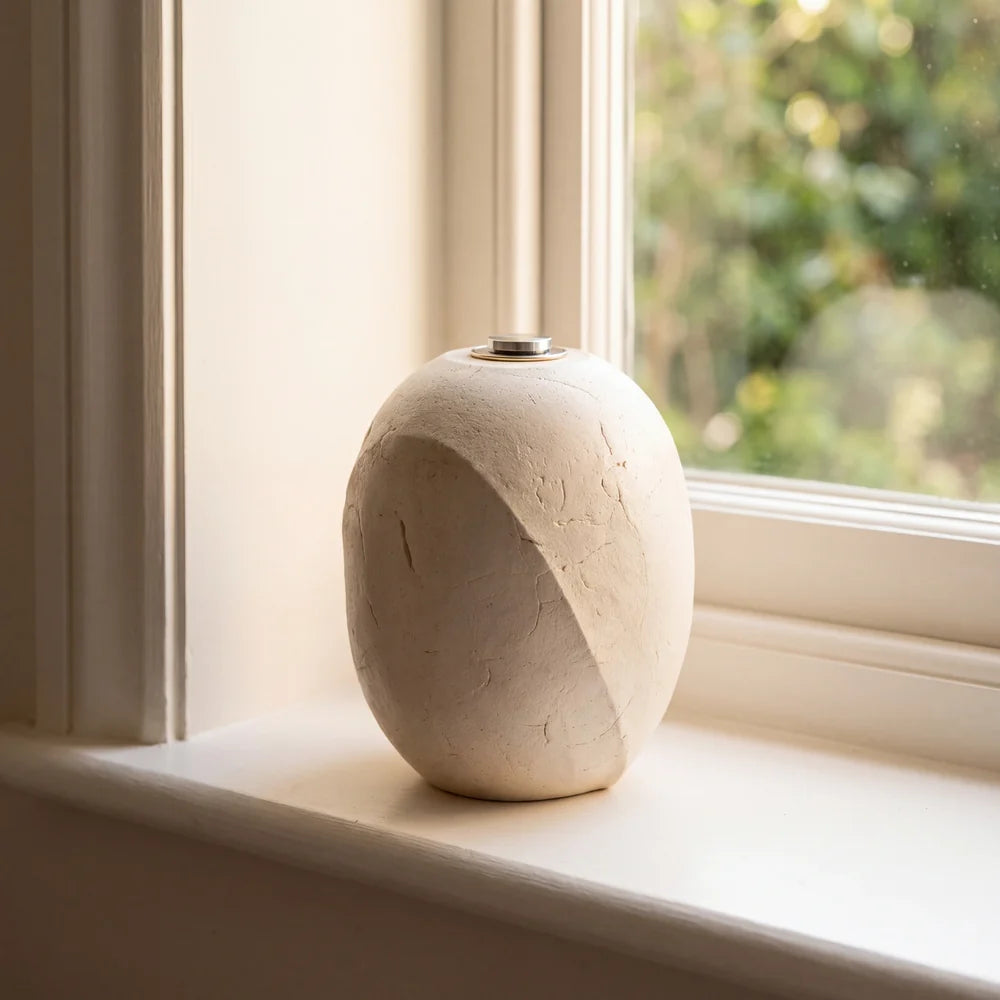
What Are Saggar Cremation Urns? How They Are Made and Who They Suit
-
11 min read
What Materials Are Used in Cremation Urns?
See every guide on Choosing an Urn: Types, Materials and Sizes


Leave a comment
This site is protected by hCaptcha and the hCaptcha Privacy Policy and Terms of Service apply.