
Scattering Ashes Ceremony: Ideas, Words and What to Bring

Quick answer: A scattering ashes ceremony is a short, informal gathering in a place that mattered to the person. Most follow the same simple order: a welcome, a few words or a reading, the scattering itself, a moment of quiet and a goodbye. There is no set form, so you can keep it as plain or as personal as you like.
Nobody has to lead a scattering ashes ceremony in a particular way, and that freedom can feel daunting when you are the one planning it. This guide sets out a simple order to follow, ideas for words, music and small gestures, how to choose the place and time, and what to carry the ashes in. Near the end there is a short section on the rules to check in England and in the United States.
Take from it only what feels right. A ceremony with three people and one sentence spoken is still a ceremony.
A simple order for the ceremony
If you would like a shape to follow, this one works for most families and most places.
- Gather and welcome. One person thanks everyone for coming and says why this place was chosen.
- Words. A reading, a poem, a prayer, or a few memories. Two or three short contributions are easier to listen to outdoors than one long one.
- The scattering. One person scatters, or the container is passed so that each person who wishes to can take a turn.
- Quiet. A minute of silence, or a piece of music played on a phone or a small speaker.
- Goodbye. A closing line, a toast, or simply a walk back together.
It helps to decide beforehand who will speak, who will hold the ashes, and who would rather only watch. Some people find they cannot scatter when the moment comes, and it is kind to have someone ready to step in.
Ideas to make the ceremony personal
- Ask each person for one memory. A single sentence each is enough, and it means nobody has to write a speech.
- Play their music. One song they loved says a great deal. Keep the volume low if other people are nearby.
- Choose the hour. Early morning and the hour before sunset are usually quieter, and the light is softer.
- Scatter fresh petals with the ashes. Loose petals or flower heads from the garden, with no ribbon, wire or wrapping, leave nothing behind on land.
- Bring something to share afterwards. Their favorite drink in a flask, or the cake they always made, gives people a reason to stay and talk.
- Write messages at home. Letters and cards can be read aloud at the ceremony and then taken home again, rather than left at the site.
- Give children a part. Holding the flowers, choosing the song, or carrying a small tube of their own helps a child feel included.
We would leave out balloons and sky lanterns. Whatever goes up comes down somewhere else as litter, and the same is true of plastic flowers, glitter and confetti. The simplest aim is to leave the place exactly as you found it.
Choosing the place and the time
The best place is usually the obvious one: the hill they walked, the beach of family vacations, the garden they looked after. A cemetery or a family grave is another possibility; the cemetery office can tell you whether it allows scattering and what it asks for. Before you settle on it, ask yourself three practical questions.
- Can everyone get there? A clifftop that suited them at forty may not suit their brother at eighty. A viewpoint near a parking lot can mean just as much.
- Will you want to come back? A private garden feels close, but houses are sold. A public place stays open to you.
- Whose land is it? If it is not yours, ask the owner or the body that manages it. The rules section below says what to check, and who to ask, in two countries.
For the date, an anniversary or birthday gives the day meaning, but a calm, dry day matters more than the perfect date. Check the forecast, stand with the wind at your back, and scatter low, close to the ground or the water. Our guide on how to scatter ashes goes through the methods step by step.
What to carry the ashes in
The container the ashes come home in is often not easy to pour from outdoors. A scattering tube is made for this one job: it is light, it is held in one hand, and it lets the ashes out in a steady stream instead of all at once.
The Bluebell Forest Scattering Tube in the adult size holds 3.93 liters (about 240 cubic inches). It stands 36.8 cm (14.5 in) tall and 13 cm (5.1 in) wide, and weighs 0.39 kg (0.9 lb) empty. It is made from recycled paper with no metal or plastic parts. To fill it, its page says to open the lid, fit the biodegradable bag inside, and fill to the level you need. On the day you remove the lid, open the perforated push-in tab, and tip the tube gently so the ashes leave in a steady stream. The print is a dappled woodland green with bluebell flowers. Go by the capacity figure when you check it against the amount of ashes you have.

Pictured: Bluebell Forest Eco Friendly Scattering Tube for Ashes - Adult
If the family plans to scatter in more than one place, or several people would each like to scatter a little, small tubes are simpler than reopening one large one. The Mountain View Scattering Tube in the mini size holds 0.33 liters (about 20 cubic inches) and is 13.3 cm (5.2 in) tall and 7.5 cm (3.0 in) wide. It is made from recycled paper with no metal parts or plastic lining. You remove the lid to add a small portion of ashes and press it firmly back in place. When you are ready, you pull the perforated tab, holding the tube away from your body, to open a channel for scattering.

Pictured: Mountain View Eco Friendly Scattering Tube for Ashes - Mini
Who a scattering tube does not suit: a tube is for carrying and scattering, not for keeping. If you expect to hold on to the ashes for months or years before the ceremony, or to keep some at home afterwards, a lasting urn is the better choice. Our small urns for ashes are made for keeping a portion. And a mini tube holds a small portion only.
If the ceremony is on water
There are two ways to do it. You can scatter straight onto the surface from a tube, keeping low and with the wind at your back so that it carries the ashes away from you. Or you can use a water urn, which is placed on the water whole and is made to sink and break down.
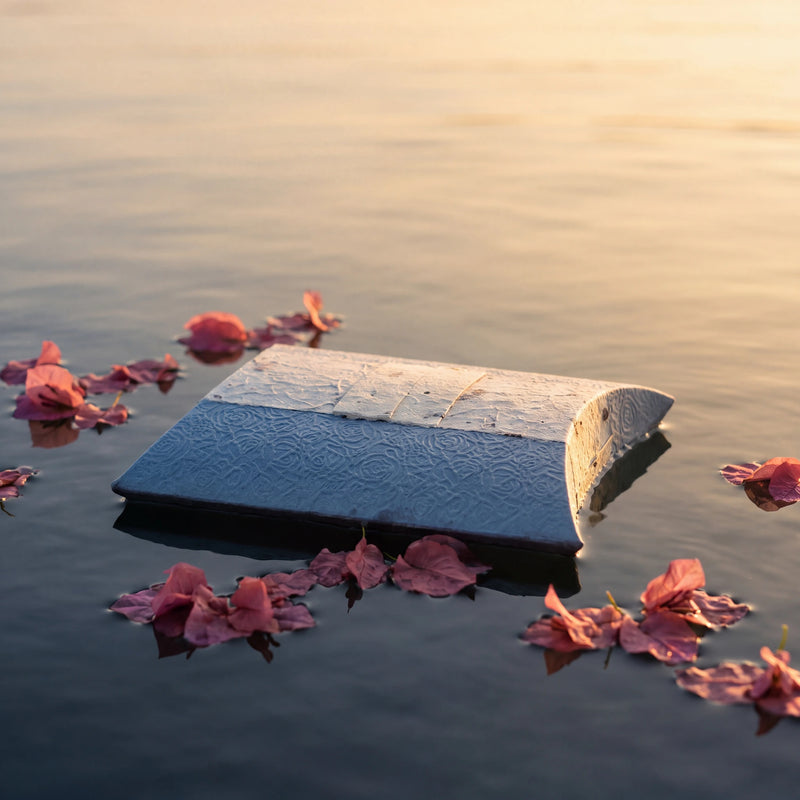
The Journey Biodegradable Water Urn in Aqua is sized for one adult. It holds 3.61 liters (about 220 cubic inches), which its page lists as suitable for an adult up to approximately 99 kg (218 lb). It measures 31.5 cm (12.4 in) high, 35.5 cm (14.0 in) wide and 7.5 cm (3.0 in) deep. The ashes go inside in the biodegradable bag supplied, and it closes without glue. Its page describes it as "designed to float for a short time, then sink gently", and as breaking down naturally over time.

Pictured: Journey Biodegradable Water Urn for Ashes in Aqua - Adult
Who a water urn does not suit: its page describes it as "designed for a farewell on open water" and as "made specifically for water", so for a ceremony on land a scattering tube is the one to look at. Rules about containers in the water also differ from place to place: the United States section below quotes a federal rule about containers that float, and the England section says who to ask there. Read them and ask the authority for your stretch of water before you buy. Our guide to water burial ceremonies explains how the day usually runs.
The three containers side by side
- Bluebell Forest Scattering Tube, adult: 3.93 liters (about 240 cubic inches). Lid comes off, perforated push-in tab opens. For scattering in a place that mattered.
- Mountain View Scattering Tube, mini: 0.33 liters (about 20 cubic inches). Lid comes off, perforated tab pulls open. For one person's small portion, apart from the main scattering.
- Journey Water Urn in Aqua, adult: 3.61 liters (about 220 cubic inches). Closes without glue. For placing whole on open water, where the rules for that water allow it.
Rules to check before the day
This is general information, not legal advice. Rules differ between countries, states and individual sites, so confirm with whoever manages the place you have chosen. Our guide to scattering ashes laws, regulations and permits covers more.
England
We give no single rule for England here, because rules and permissions differ by place and by landowner. Before you scatter on or near water, ask the landowner, the local authority or the Environment Agency.
As one local example, the Funeral Ash Scattering Guidelines for Bedford Borough (a leaflet dated July 2024, published on Bedford Borough Council's website, which gives an Environment Agency email address for further information) name one location as suitable for scattering ashes in the River Great Ouse, next to Queens Bridge in Kempston, and say: "You do not need prior approval to scatter ashes." The same leaflet says: "Ashes themselves have little impact on water quality; other items should not be placed in the water with the ashes." Of personal items and wreaths it says: "They must not be put into the water or left on the riverbank where they could be washed into the water." These guidelines were written for Bedford Borough only. Other places and other landowners have their own conditions and exceptions, so ask before the day.
If you would like to place a water urn in the water in England, ask the Environment Agency or the local authority first, since the Bedford leaflet quoted above says other items should not be placed in the water with the ashes. If you need to cross or gather on private land to reach the water, ask the owner.
United States
For the ocean, the Environmental Protection Agency's Burial at Sea page (last updated August 26, 2026) gives the main rule in these words: "Cremated remains shall be buried in or on ocean waters of any depth provided that such burial takes place at least three nautical miles from land." It also says "You must notify the EPA of the burial at sea within 30 days following the event", and that the general permit does not require an application or prior notice. The page sets out further conditions and exceptions, so read it in full before the day.
Three of those conditions matter for a ceremony. On flowers, the page says "Flowers and wreaths consisting of materials that are readily decomposable in the marine environment may be placed at the burial site." On containers, it says ashes may be buried at sea in an acceptable container, and that "The container must not contain plastic of any kind, float, or otherwise contribute to marine debris." The Journey water urn's own page describes it as designed to float for a short time before it sinks, so if you are thinking of using it, or any water urn, in United States ocean waters, read that rule on the EPA page and check with the EPA first. If in doubt, scatter the ashes directly. And the page says the general permit authorizes the burial at sea of human remains only.
Lakes and rivers are a separate matter. The same page says "Scattering of cremated remains in lakes, rivers, or other inland waters is not subject to federal regulation under the MPRSA", the federal law behind the burial at sea permit, and that states may have their own requirements. It adds: "Burial of cremated remains in inland waters is prohibited in some states." It suggests contacting the state environmental agency, health agency or mortuary board.
National parks set their own conditions. As one example, Yellowstone National Park's Scattering of Ashes Permit page (last updated May 1, 2025) says a Special Use Permit is required, that there is no fee, and that no memorial items such as plaques, urns, photos or flowers may be left in the park. Other parks differ, so read the page for the park you have in mind.
Afterwards: a place to return to
Scattered ashes leave no marker, and some families miss having one. A few gentle ways to keep the connection:
- Note the exact spot on a map or save the location on a phone, and share it with the family.
- Take a photograph of the view, not only of the people.
- Plant a tree or a rose at home in their name, where you are free to do so.
- Ask the site about its own memorial schemes, such as a bench or a tree, before putting anything in place yourself.
- Keep a small portion of the ashes back in a keepsake, if having something at home would comfort you.
If you are still deciding on the kind of farewell, our guide to unusual ways to scatter ashes has more ideas.
Sizes and product details in this guide were checked against our product pages on October 9, 2026.
Frequently asked questions
What happens at a scattering ashes ceremony?
Most ceremonies follow a simple order: a welcome, a reading or a few memories, the scattering itself, a moment of quiet or music, and a goodbye. There is no set form, and it can be as short as you wish.
What do you say when scattering ashes?
Anything honest is enough. Many families use a short poem or prayer, one memory from each person, or a single line of thanks and goodbye. Short contributions are easier to hear and to say outdoors than a long speech.
Who should scatter the ashes?
There is no rule. One person can scatter on behalf of everyone, or the container can be passed so that each person who wishes to takes a turn. Agree it beforehand, and have someone ready to step in if it proves too hard on the day.
Can you scatter ashes in more than one place?
Yes. Many families divide the ashes so that a portion can be scattered in each place that mattered, and small scattering tubes make this simpler than reopening one large container.
What can you scatter with ashes?
Fresh loose petals or flower heads with no ribbon, wire or wrapping are the usual choice on land. On water, check the rules for the place first, because they differ from one place to another.
Do you need permission to hold a scattering ceremony?
It depends on the country and the place. As a general rule, ask the owner or manager of any land that is not yours, and check the official guidance for rivers, the sea and parks before the day.
Scatter Tubes for Ashes
See all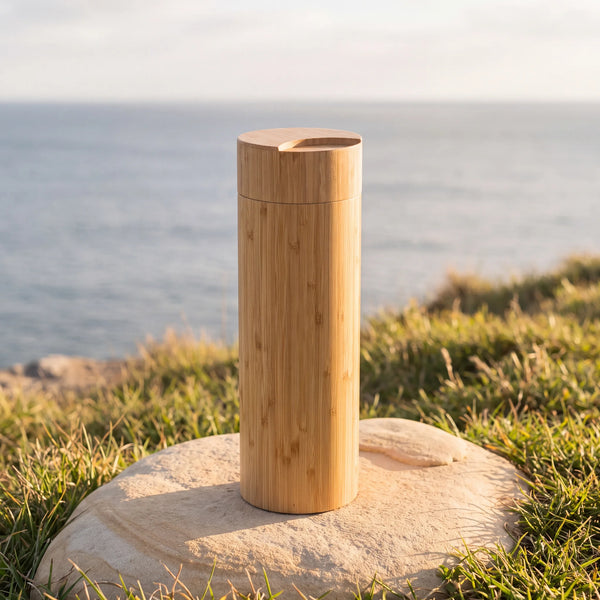 Eco Bamboo Biodegradable Scattering Urn for Ashes – Adult
 Wildflower Adult Biodegradable Scattering Urn
 Rainbow River Eco Friendly Scattering Tube for Ashes - Adult
 Natural Fibre Small Biodegradable Scattering Urn
Written by Urns For Angels
Looking for an urn?
Browse the full range, or ask us and we will help you find the right one.
Keep reading
-
16 min read
Columbarium Niche: Sizes, Costs and Which Urn Fits
-
9 min read
Dividing Ashes After Cremation: How Families Share Them
-

18 min read
How Are Cremation Urns Buried?

See every guide on What to Do With Ashes: Scattering, Burial and Keeping


Leave a comment
This site is protected by hCaptcha and the hCaptcha Privacy Policy and Terms of Service apply.