


How to Create a Memorial Garden at Home
Quick answer: A memorial garden is a planted place set aside to remember someone, and at home it can be as small as one flower bed or a few pots by a seat. Choose a spot you will pass or see every day, plant things that remind you of them, add somewhere to sit and a marker with their name, and decide separately, and without hurry, whether their ashes will rest there.
You do not need a large garden, a design, or any skill with plants. This guide explains how to create a memorial garden at home in the order most people work through it: what the words mean, where to put it, what to plant, what to add, and what to think about before ashes are placed there. It is written for a person or a pet, for a house with a lawn or a flat with a balcony.
Where an urn is mentioned, it comes from our outdoor urns for ashes or our biodegradable burial urns, and every size is taken from the page for that urn.
What a memorial garden is
A memorial garden, sometimes called a memory garden, is any planted space made in remembrance of someone. At home it is private and entirely yours to shape. It does not have to hold ashes. Many are made by people whose relative is buried elsewhere, or whose ashes were scattered years ago.
The words are also used for public places, which can be confusing when you search:
- Garden of remembrance. The usual name in the United Kingdom for the landscaped grounds at a crematorium or cemetery where ashes are scattered or buried and where families can place a plaque, a rose or a tree.
- Cremation garden or interment garden. Names used mostly by cemeteries in the United States for a section set aside for cremated remains, with burial plots for urns, niches and sometimes a scattering area.
If one of those is what you are looking for, the crematorium or cemetery office will explain what it offers and what it charges. The rest of this guide is about making a place of your own.
Choosing the spot
Walk around the garden at different times of day before you decide. Three things matter more than size.
- Will you see it? A bed you can look at from the kitchen window or pass on the way to the door becomes part of ordinary days. A far corner suits someone who would prefer to visit on purpose.
- What will grow there? Notice how many hours of sun the place gets and whether the ground stays wet after rain. It is easier to choose plants that like the spot than to change the spot.
- Will it be left alone? Keep away from ground that may be dug later for drains, cables, a vegetable bed or an extension.
No garden? A group of pots on a balcony or beside the back door is a memorial garden too, and it has one real advantage: it moves with you.
What to plant
Start with what they loved. The rose they always grew, the tomatoes they fussed over, the lavender by their old front door: a plant with a story will mean more to you than one chosen from a list of meanings.
If you would like a plant with a tradition behind it, rosemary is the best known. Writing about the authors of the flower dictionaries that were fashionable in Britain and America in the nineteenth century, the Royal Horticultural Society's library says: "Some insisted on retaining meanings familiar from Shakespeare, for example that rosemary is for remembrance, as declared by Ophelia in Hamlet." That is from its article The language of flowers: a lover's code (read October 6, 2026).
A few practical thoughts:
- Mix something evergreen with things that flower at different times, so the place is never bare.
- Bulbs planted in autumn come back each spring with no work, and children can help plant them.
- Think about a date. Something that flowers around a birthday or an anniversary gives that day a small ritual.
- Choose plants you can look after. A memorial that struggles can become one more thing to feel sad about, and a nursery near you will know what is easy in your soil and climate.
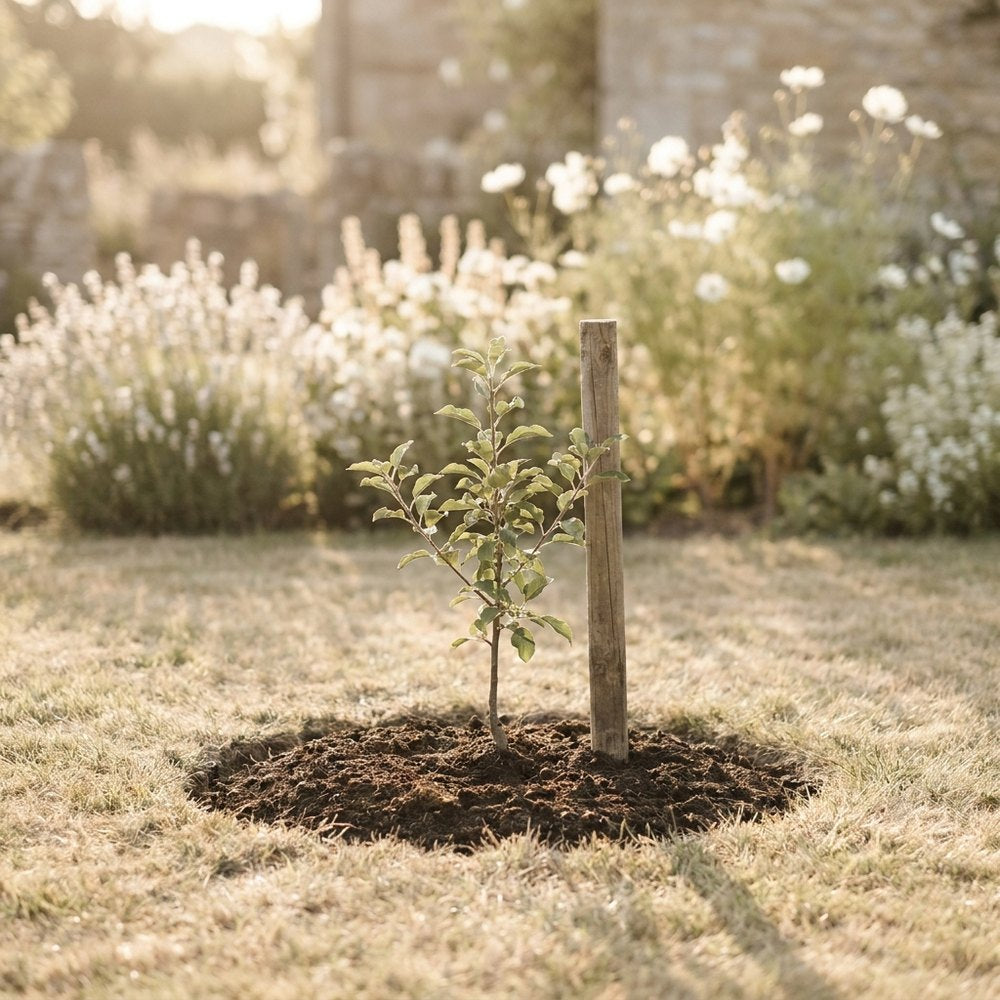
A tree makes a lasting center for a larger garden. If you are thinking of planting one over ashes, read our guide on how to grow a tree from ashes first, because it is not as simple as it sounds.
Somewhere to sit, a marker and light
A seat is what turns a flower bed into a place to spend time. It does not need to be a bench. A chair they used, or a flat stone, will do.
A marker says who the garden is for. A plaque, a carved stone, a slate with a few words written in paint, or simply an object of theirs: a watering can, a pair of boots turned into planters, a bird feeder for someone who watched the birds. For a pet, a collar tag fixed to a stake or a stone by a favorite sunny patch is enough. There are more thoughts in our guide to memorial ideas for a pet.
Other touches families add: a low fence or a border of stones to mark the edge of the space, a photograph in a weatherproof frame, a stone statue (an angel, a dove, or a dog or cat for a pet), or a bench with their name engraved on it. These are ideas to look for locally. Statues, benches and edging are not things we sell.
Solar lights give a soft glow in the evening without wiring. If you use candles, keep them in a lantern and never leave them burning.
Including ashes in a memorial garden
This is a separate decision from making the garden, and it can wait. Ashes can be kept safely at home for as long as you need. There are three ways families include them.
An urn that stands in the garden
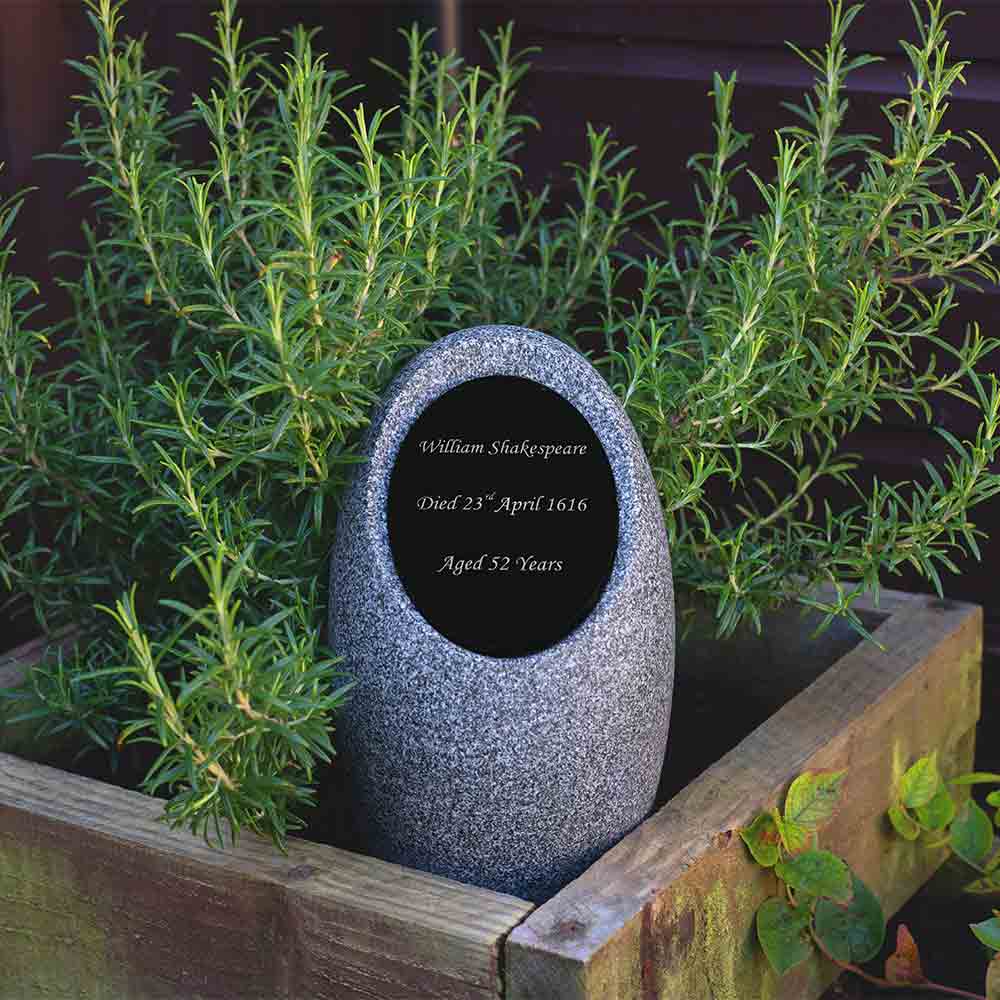
An urn made for outdoors can sit among the plants and be lifted if you ever leave. The page for the HighDown Outdoor Urn for Ashes with Plaque says it was designed with one worry in mind: leaving buried ashes behind when a family moves home. It is an egg-shaped urn in molded polypropylene with a granite effect finish, listed for the ashes of an adult or a larger pet. It holds 3.2 liters (about 195 cubic inches) and is listed as 18 x 15 x 27 cm (about 7.1 x 5.9 x 10.6 in). It closes with a screw cap in the base and comes with an oval black acrylic plaque for the front. Its page says it can be kept indoors, stood on a patio or buried in the garden, and advises keeping it out of prolonged direct sunlight, so a lightly shaded bed suits it better than an open, sunny one.

Pictured: HighDown Outdoor Urn for Ashes with Plaque - Black Perspex
If the HighDown urn is buried, the separate HighDown Marker Post Set shows where it lies: the lower part of the post stays in the ground and the upper part lifts out for mowing. Its page describes it as a way to locate a buried urn so that the ashes can be moved if you move home. Finding the urn is only the practical half. Whether you need permission to lift it depends on where you live, and in England and Wales a licence is involved, as the section "Before you bury or scatter ashes at home" explains below.
For something closer to sculpture, the Tree of Life Adult Urn in Corten Steel is an upright oval ring of rust-brown metal with the silhouette of a bare tree standing in its center, 36 cm (14.17 in) high and 6.5 kg (14.3 lb) empty. It holds 3.5 liters (about 214 cubic inches) and its page lists it for display indoors or outdoors, with a rust-colored surface that deepens with age outside. There are more designs in our guide to garden urns for ashes.
An urn buried in the garden
If you want the ashes to become part of the garden, choose an urn that breaks down in the soil. The Purity Earthurn Biodegradable Urn in White is made by hand from mulberry tree bark. It is a low, lidded shape in white, with the fibers of the bark showing in the surface, 14.0 cm (5.5 in) high, 24.1 cm (9.5 in) wide and 17.1 cm (6.7 in) deep. It weighs 0.5 kg (1.1 lb) empty and holds 3.44 liters (about 210 cubic inches), listed as suitable for an adult up to approximately 95 kg (209 lb). The lid lifts off, and its page says it returns to the earth naturally once buried.

Pictured: Purity Earthurn Biodegradable Urn for Ashes in White - Adult
Side by side:
- HighDown Outdoor Urn: 3.2 liters (about 195 cubic inches), screw cap in the base, stands on a patio or in a bed, or can be buried.
- Tree of Life in Corten Steel: 3.5 liters (about 214 cubic inches), lid, for display indoors or outdoors.
- Purity Earthurn in White: 3.44 liters (about 210 cubic inches), lift-off lid, for burial.
Check the capacity before the look. Our urn size guide shows how to work out what you need.
Scattering
Some families scatter the ashes over a bed or under a tree. Spread them thinly over a wide area, or dig them lightly into the soil, instead of leaving them in one heap around a single plant. Our guide on how to scatter ashes goes through the practical side.
Before you bury or scatter ashes at home
We cannot give you one rule that holds everywhere, and we have not tried to. If you rent, or the garden is shared or belongs to someone else, speak to the owner before you do anything. A funeral director, or your local council or county office, can tell you what applies where you live. What follows is general information, not legal advice.
England and Wales
We did not find a current GOV.UK page that states whether ashes may be buried or scattered in a private garden, so we do not state a rule here. Please check with a funeral director or your local council. What the official pages do cover is moving ashes afterwards, and that is worth knowing before you bury them. The Ministry of Justice page Apply to exhume human remains (last updated March 24, 2020; read October 6, 2026) says its form is for use "to apply for a licence to remove buried human remains (or cremated remains) from a grave or memorial in England and Wales". The guidance notes attached to the form itself (read October 6, 2026) say, in their own words:
- On an urn in the ground: "A licence should be sought for buried cremated remains in a container."
- On scattered ashes: "It is not practical to remove scattered remains. They are not considered to be buried and no licence is therefore required if they are to be disturbed."
- On a garden: "Where remains have been buried on private land (such as in a garden or field), the land owner would be considered the burial authority and should complete PART B of the form."
- On whoever owns the land at the time: "Nor would a licence normally be granted if there is an objection from the owner of the land in which deceased is buried".
Those are the main points only. The same notes set out exceptions and special cases, among them ground consecrated by the Church of England and ashes placed in the ground without a container, so read them in full or ask the Ministry of Justice before you rely on any one line. For a garden, the practical meaning is this: a marker post helps you find a buried urn, but in England and Wales lifting it is a matter for that licence application, and once a house is sold the land has a new owner.
United States
We did not find one official United States page that sets out the rules for burying or scattering ashes in a home garden, so we do not state a rule here. Please ask your state or county office, or a funeral director licensed where you live, before you bury or scatter on your own land.
Our guide to burying cremated ashes in your garden covers this in more detail, including what happens when a house is sold.
When a memorial garden at home is not the right choice
It suits someone who is settled, has a little outdoor space, and finds comfort in looking after living things. It suits less well a rented home, a house you expect to sell, or a time when a garden feels like one more job. In those cases keep it movable: pots, a seat, an urn that stands above ground, and nothing buried. If relatives live far apart and each want somewhere to visit freely, a plot or plaque in a garden of remembrance may be kinder to everyone, and the ashes can be shared so that a portion stays with you. Our guide to dividing ashes after cremation explains how that is done.
Does a memorial garden help with grief
Many people say that having something to plant, water and return to helps, though no garden takes grief away, and there is no right way to feel when you are in it. There is some evidence that plants close to home are good for us in general. In a trial in Salford, England, run by the Royal Horticultural Society with the universities of Sheffield, Westminster and Virginia, plants were added to the bare front gardens of 42 residents: "Before the experiment 24% of residents had healthy cortisol patterns. Over the course of the year following the plantings, this increased to 53% of residents." That is from the RHS article Greener gardens promote healthier residents (published October 5, 2020; read October 6, 2026). These are the results of one small trial in England, reported in 2020, not national figures, and the trial was about stress, not bereavement. Take it as encouragement and not a promise.
If you are struggling, our support organizations page lists places that can help.
Sizes and product details in this guide were checked against our product pages on October 6, 2026.
Frequently asked questions
How do I make a memorial garden at home?
Choose a spot you will see or pass every day, plant things that remind you of the person or pet, and add a seat and a marker with their name. A statue, a weatherproof photo or a border of stones can make it more personal. It can be a single bed or a group of pots. Whether ashes rest there is a separate decision that can wait.
What is the difference between a memorial garden and a garden of remembrance?
A memorial garden is any planted space made to remember someone, often at home. A garden of remembrance usually means the landscaped grounds at a crematorium or cemetery where ashes are scattered or buried and plaques are placed.
Can I put ashes in a memorial garden?
Families include ashes in three ways: in an outdoor urn that stands among the plants, buried in a biodegradable urn, or scattered thinly over the soil. We cannot give one rule for every place, so before you bury or scatter, check with a funeral director or your local council or county office, and speak to the owner if the land is not yours.
What plants are good for a memorial garden?
The ones the person loved come first. Rosemary has a long tradition as the plant of remembrance. Mix an evergreen with bulbs and flowers that bloom at different times, and choose plants that suit your soil and that you can look after.
Can I make a memorial garden without a garden?
Yes. A few pots on a balcony, a window box or a planter beside the door can be a memorial garden, and it can move with you if you change homes.
Can I create a memorial garden for a pet?
Yes. The same ideas apply. Many people choose the place where the pet liked to lie, and mark it with a stone, a plant or the tag from a collar.
Outdoor Urns for Ashes
See all The Passage Adult Cremation Urn for Ashes in Red
 Serenity Adult Cremation Urn for Ashes in Oily Blue Melange
 Infinity Adult Cremation Urn for Ashes in Red
 Harmony Adult Cremation Urn for Ashes in Glossy Black
Written by Urns For Angels
Looking for an urn?
Browse the full range, or ask us and we will help you find the right one.
Keep reading
-
3 min read
How to Grow a Tree from Your Loved One's Ashes
-
9 min read
How to Scatter Ashes: A Complete Guide
-
4 min read
Scattering Ashes - The Laws, Regulations, and Permits
See every guide on What to Do With Ashes: Scattering, Burial and Keeping


Leave a comment
This site is protected by hCaptcha and the hCaptcha Privacy Policy and Terms of Service apply.