



Pet Cremations: How Common They Are and Why
Quick answer: Pet cremations are now the usual choice in the United Kingdom, where two thirds of pet owners have their pet cremated at the end of its life, according to the Competition and Markets Authority's final report on veterinary services (March 24, 2026). Cremation does not depend on having a garden, and an individual cremation returns the ashes so a pet can be kept close, shared among the family or scattered later.
If you are reading this because you have just lost a pet, or expect to soon, we are sorry. This guide sets out what is actually known about pet cremations: how common they are, why so many owners choose one, what the different types mean, and what vets in the United Kingdom now have to tell you. Every figure below comes from a regulator, a government body or a trade body, with a link so you can read it yourself.
Key facts about pet cremations
- United Kingdom: "Two thirds of pet owners have their pet cremated at the end of its life" (Competition and Markets Authority, summary of the final report, March 2026).
- United Kingdom: the same report found that pet owners "may be paying in the order of £100 more" for an individual cremation than they would with strong price competition (Competition and Markets Authority, March 2026).
- United Kingdom: vet practices must offer a basic communal cremation and give clear prices for both individual and communal cremations, with larger businesses due to comply in December 2026 and smaller ones in March 2027 (Competition and Markets Authority guidance, updated September 22, 2026).
- United Kingdom: an estimated 62% of households own one of the country's 36.5 million pets (UK Pet Food, UK Pet Population, 2026 survey).
- United States: 95 million households owned at least one pet in 2025 (American Pet Products Association, March 26, 2026).
- England: you can bury a small domestic pet such as a dog or a cat on your own land, for example in your back garden (Environment Agency, Animal burials: prevent groundwater pollution, April 1, 2022).
- United States: in a communal cremation the ashes "are not returned to owners", under the definitions of the Pet Loss Professionals Alliance (undated document, read October 11, 2026).
How common are pet cremations?
United Kingdom
The clearest figure comes from the Competition and Markets Authority (CMA), the UK's competition regulator. Its final report on veterinary services for household pets, published on March 24, 2026, states that "Two thirds of pet owners have their pet cremated at the end of its life" (CMA, summary of the final report). The report calls cremation "an important service purchased at a distressing time".
Pets are part of most homes. UK Pet Food, the trade body that surveys about 9,000 adults each January, estimates that in 2026 there are approximately 15.5 million pet dogs, in 41% of households, and approximately 13 million pet cats, in 31% of households (UK Pet Food, UK Pet Population, 2026). With pets in so many homes, a great many families face this decision each year.
One honest caution. We could not find an official body that publishes a yearly count of pet cremations in the UK, so the CMA figure shows where things stand now, not a measured rise from one year to the next.
United States
The American Pet Products Association reports that 95 million U.S. households owned at least one pet in 2025, with dogs in 53% of households (71 million) and cats in 39% (53 million) (APPA press release, March 26, 2026). We did not find a government or regulator figure for the share of American pets that are cremated, so we have not given one. Rules and practice differ from state to state.
Why so many owners choose cremation
The official sources say little about motives, so this section is our plain reading of the choices in front of an owner, not a statistic.
- It does not depend on a garden. Burial at home needs land you own and expect to keep. Many people rent, live in apartments, or know they will move.
- The ashes can stay with you. After an individual cremation the ashes come home. They can be kept in an urn, shared among family members, buried or scattered later, and they move house when you do.
- It can be arranged at the vet. A veterinary practice can arrange the cremation for you, which spares a family from organizing it themselves on the worst day.
- There is no need to decide everything at once. Ashes can be kept for as long as you like while you decide what feels right.
Burying pets came first: the Hyde Park pet cemetery in England
Marking a pet's death is not new. The Royal Parks charity describes the pet cemetery behind Victoria Lodge in Hyde Park, London, as "one of the first public pet cemeteries in the UK", where "over 1,000 dogs and cats have been laid to rest" (The Royal Parks, Hyde Park Pet Cemetery, read October 11, 2026). The first was a Maltese terrier called Cherry, whose family wanted him to lie in "the spot he had loved so well in life". The Royal Parks says burials gradually ceased by the early 1900s because the garden was full. The cemetery can still be seen on the charity's guided tours of the park.
The wish behind those small headstones is the same one behind an urn on a shelf today. What has changed is the method, and space is part of the reason: a garden in a city fills up, and ashes take very little room.
Types of pet cremation and what the words mean
United Kingdom
The CMA's report uses two terms, individual and communal cremation. The Association of Private Pet Cemeteries and Crematoria (APPCC), a UK trade body, sets out what its members promise under each. For an individual cremation: "We will cremate individual pets alone with respect, dignity and care within an enclosed chamber" and "We will return the ashes to pet owners". For a communal cremation: "We will cremate two or more pets together side by side with respect, dignity and care" and "We will not return the ashes from communal cremations to pet owners" (APPCC Consumer Code of Conduct, June 2023).
The CMA found that "the prices of communal cremations more closely reflect their costs and are a lot lower than individual cremations", and that some practices charge high mark-ups on individual cremations (CMA, summary of the final report, March 2026).
The APPCC code binds only its own members. With any provider, it is reasonable to ask exactly how an individual cremation is carried out and how the ashes are kept separate.
United States
The Pet Loss Professionals Alliance, the pet section of the International Cemetery, Cremation and Funeral Association, publishes three definitions for its members (PLPA, Definitions and Standards for the Cremation of Companion Animals, undated, read October 11, 2026):
- Private cremation: "only one animal's body is present in the cremation unit during the cremation process".
- Partitioned cremation: more than one pet is in the chamber and the ashes of specific pets are returned. The PLPA states that some mixing of ashes will occur.
- Communal cremation: "multiple animals are cremated together without any form of separation" and the ashes "are not returned to owners".
These are a trade body's standards for its own members, not law, and state rules differ.
What vets must now tell you in the United Kingdom
Following its investigation, the CMA made a legally binding Order in September 2026. Under it, every veterinary business with a general (first opinion) practice must make sure owners know their full range of options shortly before or when a pet reaches the end of its life. The CMA's guidance lists those options as: an individual or communal cremation bought from the practice, separate arrangements made directly with a crematorium, or taking the pet away for burial at home (CMA guidance for veterinary businesses, updated September 22, 2026).
Practices must also offer a basic communal cremation and give clear prices for both kinds. The guidance gives December 2026 as the date for larger businesses to comply and March 2027 for smaller ones, so some practices may not have changed yet. You are free to ask for the prices in writing and to contact a pet crematorium yourself.
For typical prices, see our guide to pet cremation costs.
Burying a pet at home in England
Cremation is a choice, not a requirement. The Environment Agency's guidance for England says: "You can bury small domestic pet animals such as a dog or a cat on your own land, for example in your back garden", and that for these small pets there are no minimum groundwater protection requirements. For a larger animal such as a pet horse, it says to follow the groundwater protection requirements and contact your local council's animal health office (Environment Agency, Animal burials: prevent groundwater pollution, published April 1, 2022).
That guidance covers England only. Rules in Scotland, Wales, Northern Ireland and each U.S. state are set separately. This is general information, not legal advice. Your vet or local council can tell you what applies where you live.
When cremation is the right choice, and when it is not
An individual cremation suits you if you want your pet's ashes back, if you have no garden of your own, or if you may move home. A communal cremation suits you if you want your pet cared for respectfully but do not wish to keep ashes. No ashes are returned, so there is nothing to place in an urn. If having something to keep matters to you, tell the vet before you choose.
Cremation may not be right if you own your garden, expect to stay, and would find comfort in a grave you can visit. Home burial keeps your pet close in a different way. None of these choices is more loving than another.
Choosing an urn after a pet cremation
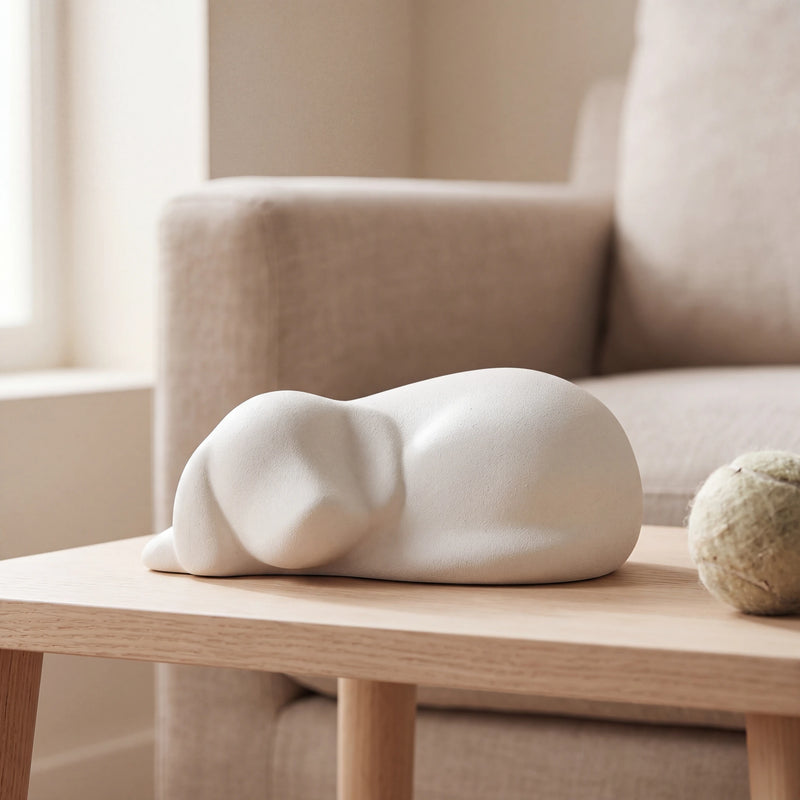
If you choose an individual cremation, the ashes are returned to you, and you can place them in an urn whenever you are ready. There is no hurry. Size is the main thing to check: our pet urns list their capacity, and the urn size guide explains how to match it to your pet.
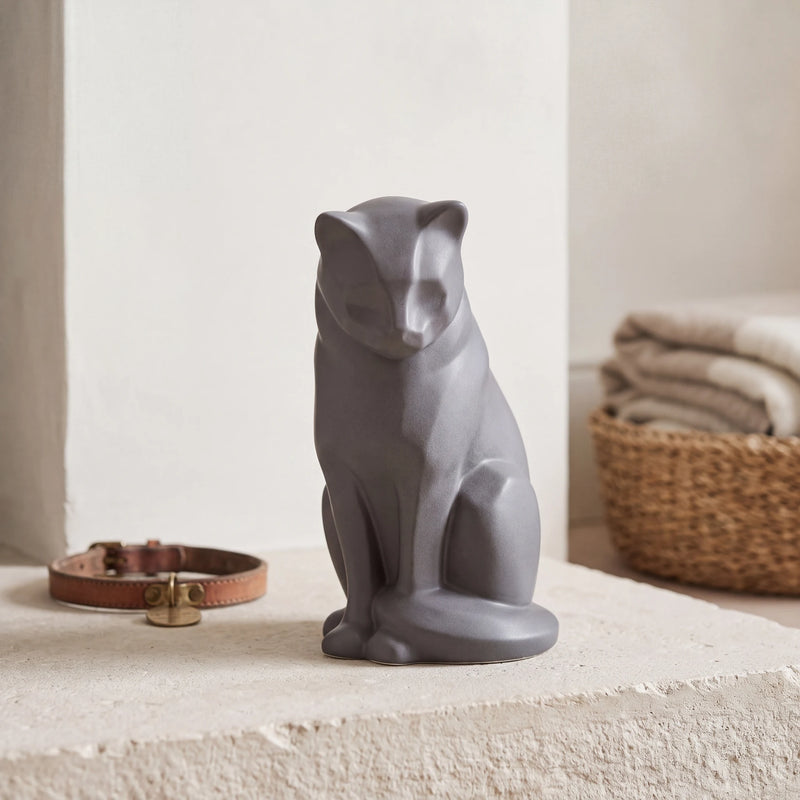
Two examples from the range. The Paw Print Pet Urn for Ashes in Light Sand is a small oval ceramic urn with lines that spiral in to a paw print at the center. It holds 0.9 liters (about 56 cubic inches), stands 20 cm (7.9 in) high and weighs 0.9 kg (2.0 lb) empty, with a space at the back for a tealight. The Sitting Cat Urn for Ashes in Dark Sand is a ceramic urn in the shape of a sitting cat. It holds 1.5 liters (about 92 cubic inches) and stands 24 cm (9.4 in) high. Both are filled through the base, which can be sealed with the glue supplied, and both are listed as suitable for indoor and outdoor display.

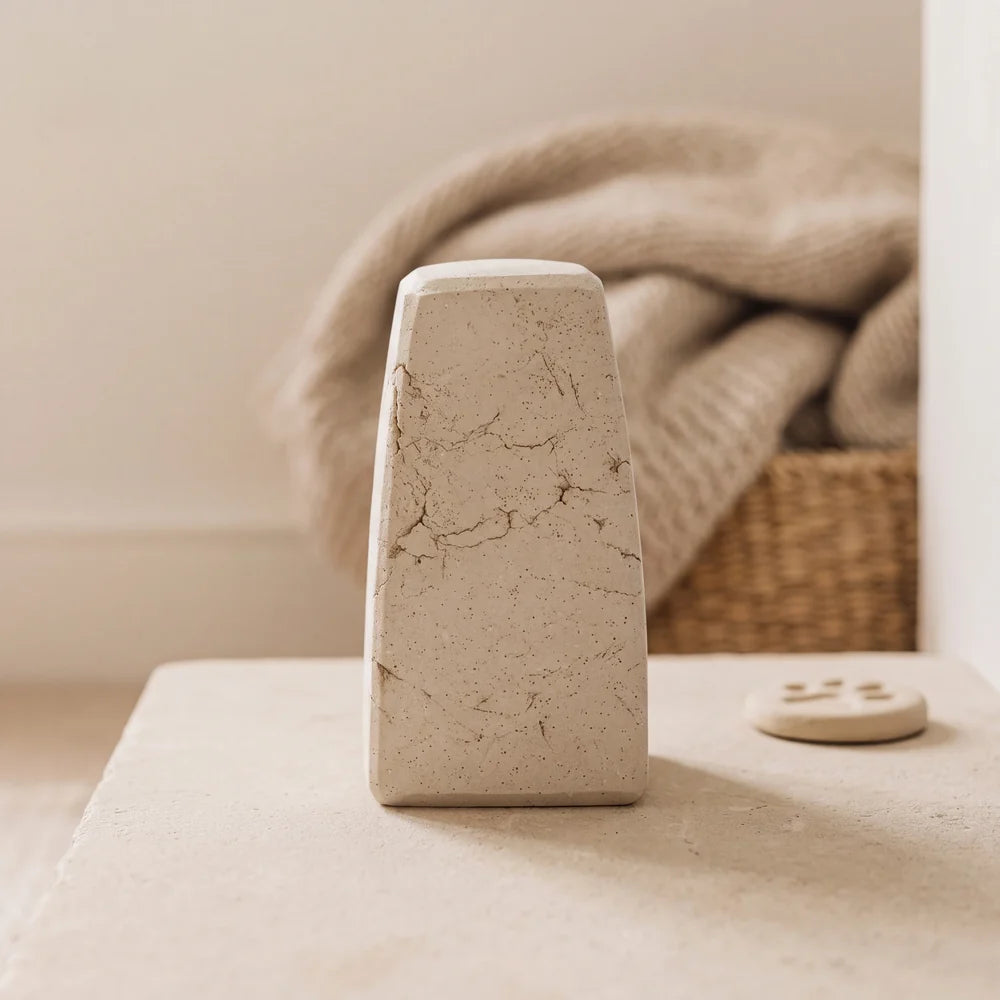
Pictured: Paw Print Pet Urn for Ashes in Light Sand
These suit ashes that are being kept. Their pages describe them for display, not for scattering or for burial in the ground. If you plan to scatter, or would like other ideas, see our guides on what to do with pet ashes and memorial ideas for a pet.
Sources
- Competition and Markets Authority, "Veterinary services for household pets: summary of the final report", gov.uk, read October 11, 2026.
- Competition and Markets Authority, "What veterinary businesses and vets need to do following the CMA's final vets report", gov.uk, read October 11, 2026.
- UK Pet Food, "UK Pet Population", ukpetfood.org, read October 11, 2026.
- American Pet Products Association, "U.S. Pet Industry Reaches $158 Billion in 2025, Poised for Continued Growth in 2026", americanpetproducts.org, read October 11, 2026.
- Environment Agency, "Animal burials: prevent groundwater pollution", gov.uk, read October 11, 2026.
- Association of Private Pet Cemeteries and Crematoria, "APPCC Consumer Code of Conduct", appcc.org.uk, read October 11, 2026.
- Pet Loss Professionals Alliance, "Definitions and Standards for the Cremation of Companion Animals", iccfa.com, read October 11, 2026.
- The Royal Parks, "Hyde Park Pet Cemetery", royalparks.org.uk, read October 11, 2026.
Sizes and product details in this guide were checked against our product pages on October 11, 2026.
Frequently asked questions
Are pets typically cremated?
In the United Kingdom, yes. The Competition and Markets Authority's final report on veterinary services, published in March 2026, states that two thirds of pet owners have their pet cremated at the end of its life. We did not find an equivalent official figure for the United States.
Why do people cremate their pets?
The common practical reasons are that cremation does not need a garden, the ashes can be kept, shared or scattered later, the vet can arrange it, and the ashes can move with the family. Many owners simply want to keep their pet close.
What is the difference between individual and communal pet cremation?
In a communal cremation several pets are cremated together and no ashes are returned. In an individual cremation your pet is cremated alone and the ashes are returned to you. Those are the terms of the APPCC code in the United Kingdom, which binds its members only, so ask any crematorium how its individual service is carried out.
Do I have to use the crematorium my vet suggests?
No. In the United Kingdom the Competition and Markets Authority's guidance says owners must be told they can buy a cremation from the practice, arrange one directly with a crematorium, or take their pet home for burial.
Can I bury my pet in the garden instead?
In England, the Environment Agency says you can bury a small domestic pet such as a dog or a cat on your own land, for example in your back garden. Rules elsewhere are set separately, so check with your vet or local council.
Can I be present at my pet's cremation?
Some pet crematoria allow owners to attend and some do not. It depends on the provider, so ask the crematorium directly before you decide.
Pet Urns
See all Sleeping Dog Pet Urn for Ashes in White
 Pawprints Pet Urn for Ashes in White - Large
 Sleeping Cat Urn for Ashes in Grey
 Paw Print Heart Mini Pet Urn for Ashes in White
Written by Urns For Angels
Looking for an urn?
Browse the full range, or ask us and we will help you find the right one.
Keep reading
-
13 min read
What to Do With Your Cat's Ashes: A Gentle Guide
-

5 min read
What can I do with My Dog's Ashes?
-
15 min read
What to Do With Pet Ashes: 10 Gentle Ideas


Leave a comment
This site is protected by hCaptcha and the hCaptcha Privacy Policy and Terms of Service apply.