
What Are Saggar Cremation Urns? How They Are Made and Who They Suit
Quick answer: Saggar cremation urns are ceramic urns fired inside a second clay container, called a saggar, together with materials such as wood shavings, salt and copper. The smoke and fumes mark the unglazed surface, so no two are alike. They are decorative pieces for keeping ashes indoors, made by studio potters.
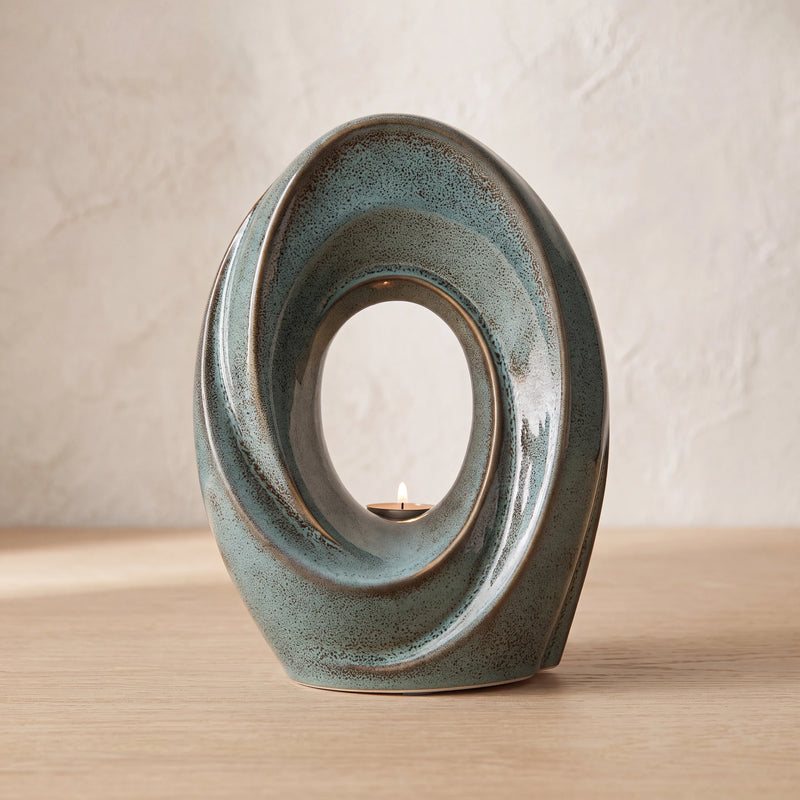
If you have seen an urn with soft, smoky markings that look more like weather than decoration, it may well have been saggar fired. This guide explains what saggar cremation urns are, how the finish is made, who they suit and who they do not, and what to ask before you buy one. We will be plain about our own range too: a saggar-fired urn is a specialist piece, and our ceramic urns for ashes get their one-off surfaces in other ways.
What is a saggar?
A saggar is a container that holds pottery while it is in the kiln. For centuries its job was protection. The Victoria and Albert Museum in London has a saggar from John Dwight's Fulham Pottery, made around 1680 to 1700, and its catalog record (read October 5, 2026) explains that saggars kept the pottery out of direct contact with the flames and allowed the kiln to be stacked efficiently.
Studio potters now use the same idea the other way around. Instead of keeping smoke and fumes away from the pot, they enclose the pot with them.
How saggar firing marks the clay
The clearest description we have found is a step-by-step account by the potters Linda and Charlie Riggs, published by Ceramic Arts Network on May 18, 2026. In their method:
- The pot is coated with a fine clay slip called terra sigillata and polished with a soft cloth (hand burnishing is an alternative). It is fired without glaze.
- It is placed in the saggar on a bed of wood shavings, with a mixture of salt and copper carbonate around the edge and strands of steel wool laid over the pot.
- A second bowl goes on top as a lid, leaving only a very small gap for air.
- The kiln is brought up to 1600°F (870°C) and held between 1600°F and 1700°F for 20 minutes, then left to cool naturally.
- Afterward the pot is wiped clean, then polished and sealed with paste wax or a clear satin spray.
The same article notes that the amount of wood shavings decides how light or dark the pot comes out, and that the practice of burnishing pots, firing them without glaze and using whatever combustible materials are to hand goes back thousands of years. The potter chooses the materials. The fire decides where the marks fall.
How saggar differs from raku and crystalline glaze
These three names come up side by side, and it helps to know how they differ.
Raku. Saggar firing and raku are close relatives. Linda and Charlie Riggs fire their saggars in a raku kiln, and their article is taken from a book on naked raku and related bare clay techniques. The difference they point to is the saggar itself: it takes the rapid changes of temperature, so the pot inside is protected, and the pot is left to cool before it is lifted out.
Crystalline glaze. This is a glaze, so it is the opposite starting point. On the crystalline glazed urns we sell, the product pages describe a glaze whose crystal patterns form naturally in the kiln. A saggar-fired urn, made as described above, is fired without any glaze. Our guide to crystalline glazed ceramics explains how that glaze works.
What that means for an urn
Three things follow from the way a saggar-fired urn is made, and they matter more than the technique itself when you are choosing where someone's ashes will rest.
The surface is clay, not glass. A glazed urn has a hard, glassy coat. In the method above, the surface is a polished coat of fine clay slip, sealed afterward with wax or a clear spray. The finish they aim for is satin to shiny, not mirror-like.
Each one is a single piece. The markings cannot be repeated, so you are choosing one particular urn, not a design. If you are buying online, ask for photographs of the actual urn from several sides.
It needs a gentle home. We would treat a waxed, unglazed surface as an indoor finish. Keep it dry, away from strong sunlight, and dust it with a soft cloth instead of washing it.
Who a saggar urn suits, and who it does not
A saggar-fired urn suits a family who want something made by one person's hands, who will keep the ashes at home, and who like the thought that the urn could not be made again. It often feels right for someone who painted, potted, gardened or simply preferred handmade things.
It is the wrong choice in a few situations:
- For a garden or other outdoor spot. Look at urns that are sold for outdoor display. Our outdoor urns for ashes are a better starting point.
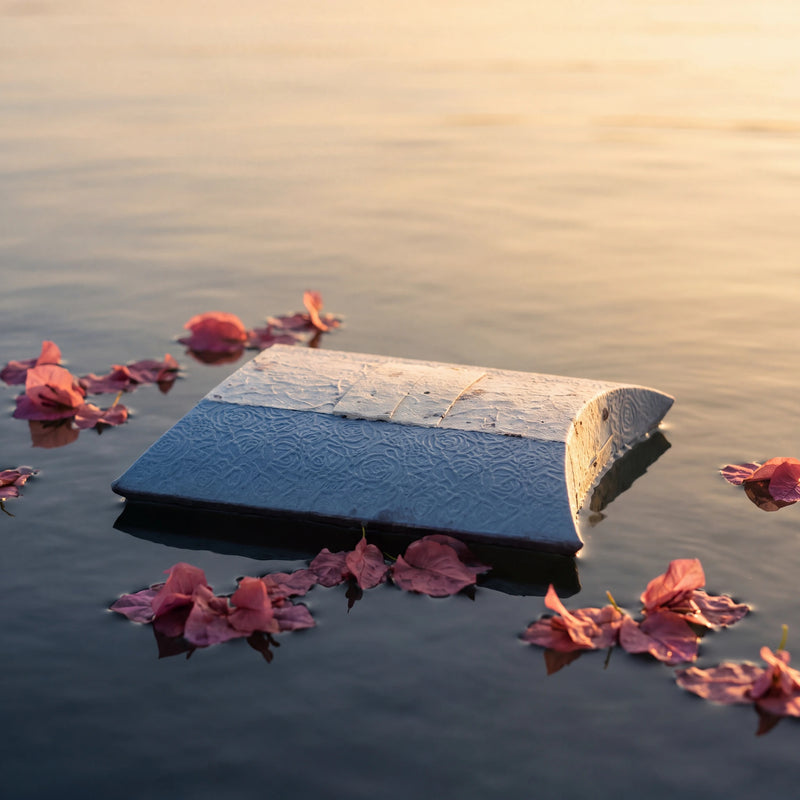
- For burial at a natural burial ground, or for a water ceremony. Fired clay does not break down. A biodegradable urn is made for this.
- If you need a particular size quickly. A potter may have only one or two finished pieces, and they may not be large enough.
- If you would like a matching set. A second urn or a keepsake will never match exactly.
Do we sell saggar-fired urns?
No. None of the urns we currently sell is saggar fired, and we would rather say so than let a similar-looking finish pass for one. If saggar is what you have set your heart on, a studio potter is the right place to go, and some will make an urn to order. Three questions are worth asking:
- How much does it hold? Ask for the capacity in cubic inches or liters, measured, not guessed. The Cremation Association of North America states on its cremation process page (read October 5, 2026) that the average weight of adult cremated remains is between four and six pounds. That is a weight, and urns are sized by volume. For volume, our own urn size guide works on a rule of thumb of about one cubic inch of capacity for each pound of body weight before cremation. It is an estimate, so allow a little extra.
- How does the lid close? A handmade lid may simply rest in place. Ask whether it can be sealed, and with what.
- How was the surface sealed? Wax and clear sprays are both used. Ask how to care for it.
One-of-a-kind ceramic urns we do sell
If what draws you to saggar is that no two pieces come out alike, the ceramic urns below share that quality. Each is described on its own page as one of a kind. They get there in different ways: three have a crystalline glaze, one has a crackle glaze, and one has a texture finished by hand. None of them is saggar fired. The crystalline ones are gathered in our crystalline glazed urns.
Jadeite Adult Cremation Urn: crystals grown in the glaze
The Jadeite Adult Cremation Urn is hand-thrown and finished with a crystalline glaze in jade and sea-green tones. The crystals form in the glaze during firing, so the pattern is different on every urn. It is a low, rounded urn with a dark lid that has a tea light holder built in. It holds 3.6 liters (about 220 cubic inches), stands 18 cm (7.09 in) high and 19 cm (7.48 in) wide, and weighs 2.4 kg (5.29 lb) empty. The Emerald Adult Cremation Urn is also hand-thrown, with a tea light holder in its lid, and holds 3.9 liters (about 240 cubic inches).

Pictured: Jadeite Adult Cremation Urn for Ashes
Sodalite Adult Cremation Urn: deep blue crystalline glaze
The Sodalite Adult Cremation Urn is handcrafted in ceramic with a deep blue crystalline glaze that develops in the kiln. In the photographs the blue crystals sit over a warmer brown ground, and the full, rounded body narrows a little toward the base. It holds 4.1 liters (about 250 cubic inches), stands 22 cm (8.66 in) high and 21 cm (8.27 in) wide, and weighs 2.2 kg (4.85 lb) empty. The lid has a sculpted neck that slots into the opening.

Pictured: Sodalite Adult Cremation Urn for Ashes
Harmony in Crackle Glaze: lines that form as it cools
The Harmony Adult Cremation Urn in Crackle Glaze is a ceramic sphere in off-white, covered in fine, web-like lines. Those lines develop by themselves as the urn cools after firing, which is close in spirit to the chance marks of a saggar. A tea candle holder is set into the top. It holds 3.2 liters (about 195 cubic inches), measures 20 cm (7.9 in) high and 19 cm (7.5 in) wide, and weighs 1.2 kg (2.6 lb) empty.

Pictured: Harmony Adult Cremation Urn for Ashes in Crackle Glaze
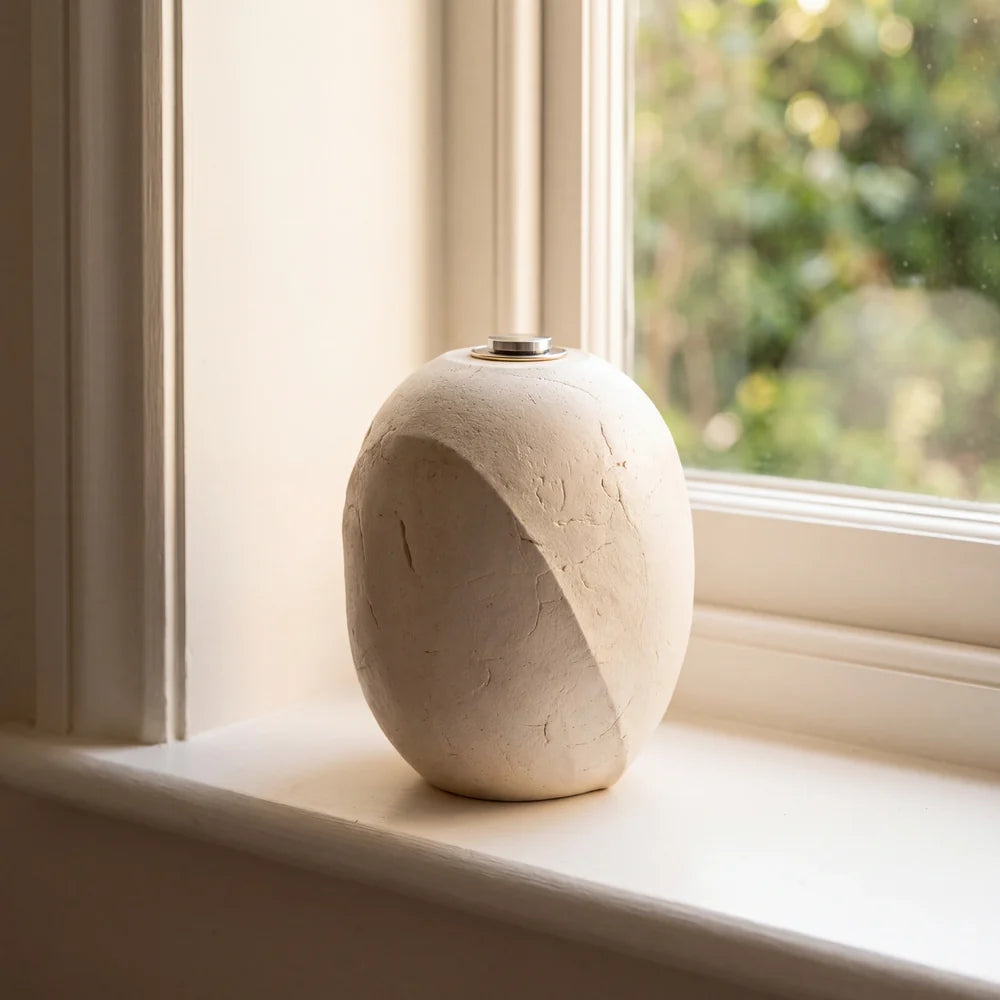
Cocoon Adult Cremation Urn: a matte, stone-like surface
If it is the quiet, unglazed look of saggar that you like, the Cocoon Adult Cremation Urn may be closer to it than any glossy glaze. It is an egg-shaped urn in stoneware ceramic, in a sandy cream tone with a raw-stone texture that is finished by hand, so the texture varies a little from urn to urn. It is not marked by smoke. It closes with a brass collar and an aluminum screw cap, with no glue needed. It holds 4.0 liters (about 244 cubic inches), measures 24 cm (9.4 in) high and 17 cm (6.7 in) wide, and weighs 3.0 kg (6.6 lb) empty.

Pictured: Cocoon Adult Cremation Urn for Ashes
Side by side
One line for each of the four urns pictured above.
- Jadeite: 3.6 liters (about 220 cubic inches). Fills through the top, and the lid can be sealed with the ceramic adhesive supplied. For display in the home.
- Sodalite: 4.1 liters (about 250 cubic inches). Fills through the top, and the lid can be sealed with the ceramic adhesive supplied. For display in the home.
- Harmony in Crackle Glaze: 3.2 liters (about 195 cubic inches). Fills through the base, which is sealed with the ceramic adhesive supplied. Indoors, or a sheltered spot outdoors.
- Cocoon: 4.0 liters (about 244 cubic inches). Fills through the top and closes with a screw cap that can be reopened. Best kept indoors.
If you are still deciding on a material, our guide on why families choose a ceramic urn covers the practical side, and how to seal a ceramic urn walks through closing one.
Sizes and product details in this guide were checked against our product pages on October 5, 2026.
Frequently asked questions
What is a saggar cremation urn?
A saggar cremation urn is a ceramic urn that was fired inside a second clay container, called a saggar, with materials such as wood shavings, salt and copper. The smoke and fumes mark the unglazed surface, so its pattern cannot be repeated.
Are saggar urns glazed?
No. In the method published by Ceramic Arts Network on May 18, 2026, the pot is coated with a fine clay slip called terra sigillata, polished with a soft cloth and fired without glaze. Afterward it is polished and sealed with paste wax or a clear satin spray.
Can a saggar urn be kept outside or buried?
We would keep a saggar-fired urn indoors, because its surface is polished clay slip sealed with wax or a clear spray, not glaze. Fired clay does not break down in the ground, so for a natural burial choose a biodegradable urn, and ask the cemetery or burial ground what it allows.
How big does a saggar urn need to be for an adult?
Our urn size guide works on a rule of thumb of about one cubic inch of capacity for each pound of body weight before cremation. Ask the potter for the measured capacity. The adult ceramic urns described in this guide hold between 195 and 250 cubic inches.
Is a saggar urn the same as a raku or crystalline glazed urn?
No. A saggar-fired urn is unglazed and is marked by smoke and fumes inside the saggar. A crystalline glazed urn is coated in a glaze in which crystals form during firing. Raku is a related studio firing, and the potters whose method is described in this guide fire their saggars in a raku kiln, but in saggar firing the pot stays inside its container and cools there.
Does Urns For Angels sell saggar-fired urns?
No, none of the urns we currently sell is saggar fired. We do sell handmade ceramic urns with a crystalline glaze, where the crystals form in the kiln, and with a crackle glaze, where fine lines develop as the urn cools after firing. The pattern is different on every urn.
Ceramic Urns
See all Infinity Adult Cremation Urn for Ashes in Crackle Glaze
 The Passage Adult Cremation Urn for Ashes in Crackle Glaze
 Harmony Adult Cremation Urn for Ashes in Amber Yellow
 Serenity Adult Cremation Urn for Ashes in Crackle Glaze
Written by Urns For Angels
Looking for an urn?
Browse the full range, or ask us and we will help you find the right one.
Keep reading
-
2 min read
What type of Scattering Tubes are there?
-
3 min read
Different Types of Wooden Urns for Ashes

Leave a comment
This site is protected by hCaptcha and the hCaptcha Privacy Policy and Terms of Service apply.