






What to Write in a Sympathy Card and on Funeral Flowers
Quick answer: In a sympathy card, say you are sorry and use the name of the person who died, add one memory or one thing you liked about them, and close with a warm line or a specific offer of help. Two to four sentences is enough. A funeral flower card needs even less: a short line of remembrance and your full name.
Knowing what to write in a sympathy card is hard because nothing you write will change what has happened. That is not what the card is for. The card tells someone that you know, that you are thinking of them, and that the person who died mattered to you too.
This guide gives a simple pattern first, then wording for different relationships, words to leave out, how to sign off, and what to write on the small card that goes with funeral flowers. Every example can be changed to fit. The best cards usually sound like the person who wrote them.
A simple pattern for any sympathy card
Most good sympathy messages have three parts. You do not need all three, and they do not need to be long.
- Say you are sorry, and use the name. "I was so sorry to hear that Margaret had died" reads very differently from "Sorry for your loss". The name shows you are thinking of a real person.
- Add one memory or one quality. Her laugh across the office. The tomatoes he grew every summer and gave away. If you never met the person, say something about what you have heard of them, or about the person you are writing to.
- Close with warmth or a real offer. "Thinking of you all" is enough. If you can help, name the help and the day.
The Emily Post Institute, the American etiquette authority, puts it simply: "Say what you truly feel. A single sincere line expressing the genuine feeling you had for the deceased is all you need to write." (Emily Post, Sympathy Notes 101, read October 21, 2026.)
Handwrite it if you can. Short and true beats long and polished.
Short sympathy messages you can adapt
These work for almost anyone. Put the name in where you see a blank.
- "I was so sorry to hear about ____. Thinking of you and sending love."
- "____ was one of the kindest people I knew. I am so sorry."
- "I have been thinking about you since I heard. With love and sympathy."
- "No words seem right, but I wanted you to know I am thinking of you."
- "I will always remember ____'s laugh. Sending you all my love."
- "With deepest sympathy, and with happy memories of ____."
What to write for different relationships
To a close friend
Write the way you would talk to them. You can be more personal, and a specific offer means a lot from a friend because they know you mean it.
"Dear Sam, I am so sorry about your mum. I loved the way she always had the kettle on before we were through the door. I will bring dinner round on Thursday, and you don't need to reply to this. All my love, Jo."
To a family member
You are both grieving, so it is fine to say so. "I keep thinking of Dad at the head of the table. I miss him already, and I know you do too. I'm here, whenever you want to talk about him or not talk at all."
To a colleague or your manager
Keep it warm and brief, and leave out anything too personal. A card signed by a team works best when each person adds a line of their own instead of only a name.
"We were so sorry to hear about your father. Please take all the time you need, and don't worry about anything here. Thinking of you, from everyone in Accounts."
To a neighbor or someone you know a little
"I was very sorry to hear about Peter. He always stopped to talk over the fence, and the street feels quieter without him. If you would like a hand with the bins or the shopping, just knock."
When you did not know the person who died
Write to the person you do know. "I didn't have the chance to meet your grandmother, but I know how much she meant to you from the way you talked about her. I'm so sorry."
For the loss of a husband, wife or partner
Use both names if you knew them as a couple. "You and David were such a team. I am so sorry, and I will be thinking of you every day this week." Avoid anything about the future, such as meeting someone new.
For the loss of a parent
Leave out lines such as "it was the natural order of things", however old the parent was. "I am so sorry about your mother. She was so proud of you, and it showed every time she talked about you" says more.
For the loss of a child or baby
Say the child's name if one was given, and do not try to explain or soften the loss. "We are so sorry that Lily has died. We are thinking of you both, and we are here for you for as long as you need us." Leave out any comparison or reassurance about the future.
After a long illness
Do not describe the illness or say that it is a relief. "I know how hard you worked to care for him. I am so sorry he has gone" recognizes the months of caring without judging how anyone feels about the end.
After a sudden death
Say less, not more. Do not ask what happened, and do not mention the cause. "I am so shocked and sorry. I'm thinking of you and I'm here" is enough.
For the loss of a pet
Use the pet's name and treat the loss as real. "I'm so sorry about Bella. She was the happiest dog on the street, and I know how much you will miss your walks together." Our guide to dog memorial gifts has more on what to send when a dog has died.
Religious and non-religious wording
If you know the family's faith and share it, a line of prayer can be a comfort: "Keeping you in my prayers," or "May God give you strength." If you are not sure, keep the wording secular. "Thinking of you," "Sending love," and "With deepest sympathy" fit every belief and none.
Phrases such as "in a better place" or "God needed another angel" can hurt someone who does not share that view, and sometimes someone who does. Use them only when you are certain they fit.
What not to write in a sympathy card
- Details of the illness or death. The Emily Post Institute advises against dwelling on the illness or the manner of death, and against calling the loss "a blessing in disguise" (Emily Post, Sympathy Notes 101, read October 21, 2026).
- "At least..." At least they had a long life, at least they are not suffering. Each one asks the reader to feel less sad.
- "I know how you feel." Even if you have lost someone in the same way, their grief is their own. Write about the person instead.
- Stories about your own loss. A line can show you understand. A paragraph turns the card toward you.
- A vague offer. Cruse Bereavement Support, the UK bereavement charity, gives this example: "'How about I pick up the children from school on Thursday?' is often better than" a general "let me know" (Cruse, How to support someone who is grieving, read October 21, 2026). If you cannot offer anything specific, leave the offer out.
Cruse also says that "it is really important to get in touch with your friend or relative and let them know you are thinking about them" (same page). So if you are worried about getting the words wrong, send the card anyway. A plain "I'm so sorry, thinking of you" is far better than no card.
How to sign off a sympathy card
Choose a closing that matches how close you are.
- Close friends and family: "All my love," "With love," "Thinking of you always."
- Friends, neighbors and colleagues: "With deepest sympathy," "Thinking of you," "With kind thoughts."
- Formal, or someone you barely know: "With sincere condolences," "With sympathy."
Sign with your first and last name if there is any chance the family will not know who you are. A family may receive dozens of cards, and a surname, or "Jo from the choir", saves them guessing.
What to write on a funeral flower card
The small card that goes with funeral flowers is read by the family and often by other mourners at the service. Dignity Funerals, a UK funeral director, says "The card that accompanies funeral flowers only needs a few kind words of remembrance." (Dignity, Funeral flowers and floral tributes, read October 21, 2026.)
Write to the person who died, or about them, and always add your full name, or the family names, so the family can thank you later.
From family
- "Mum, forever in our hearts. All our love, Sarah, Tom and the boys."
- "To Grandad, thank you for everything. We will miss you every day. Ellie and Jack."
- "My darling husband, I love you always. Your Jean."
From friends
- "Dear Ruth, a wonderful friend for forty years. Gone but never forgotten. Love, Ann and Mike Hughes."
- "In loving memory of a true gentleman. With love, the Patel family."
From colleagues, a club or a group
- "In fond memory of a much loved colleague. From all at Hill Street Surgery."
- "With sympathy and happy memories of Saturday mornings. Everyone at Riverside Bowls Club."
Before you order funeral flowers
Check the funeral notice first. Some families ask for family flowers only, or for donations to a charity instead of flowers. If they do, follow it, and write your sympathy in a card instead.
Customs also differ by faith. Dignity notes that "Flowers are not usual at a Jewish funeral, and at some Muslim funerals they are kept very simple or not used at all," and that "Hindu and Sikh funerals often use garlands rather than arrangements." The same page recommends "sending funeral flowers and floral tributes straight to the funeral home or where the funeral service is being held." (Dignity, Funeral flowers and floral tributes, read October 21, 2026.) If you are unsure, the funeral director can tell you what the family has asked for.
If you want to send something with the card
A card is enough on its own. Some people like to add a small thing the family can keep after the flowers have gone, such as a candle to light on the evenings that are hardest. Our candle urns and keepsake candles include a few pieces that hold no ashes at all, so they make no assumptions about what the family has decided.
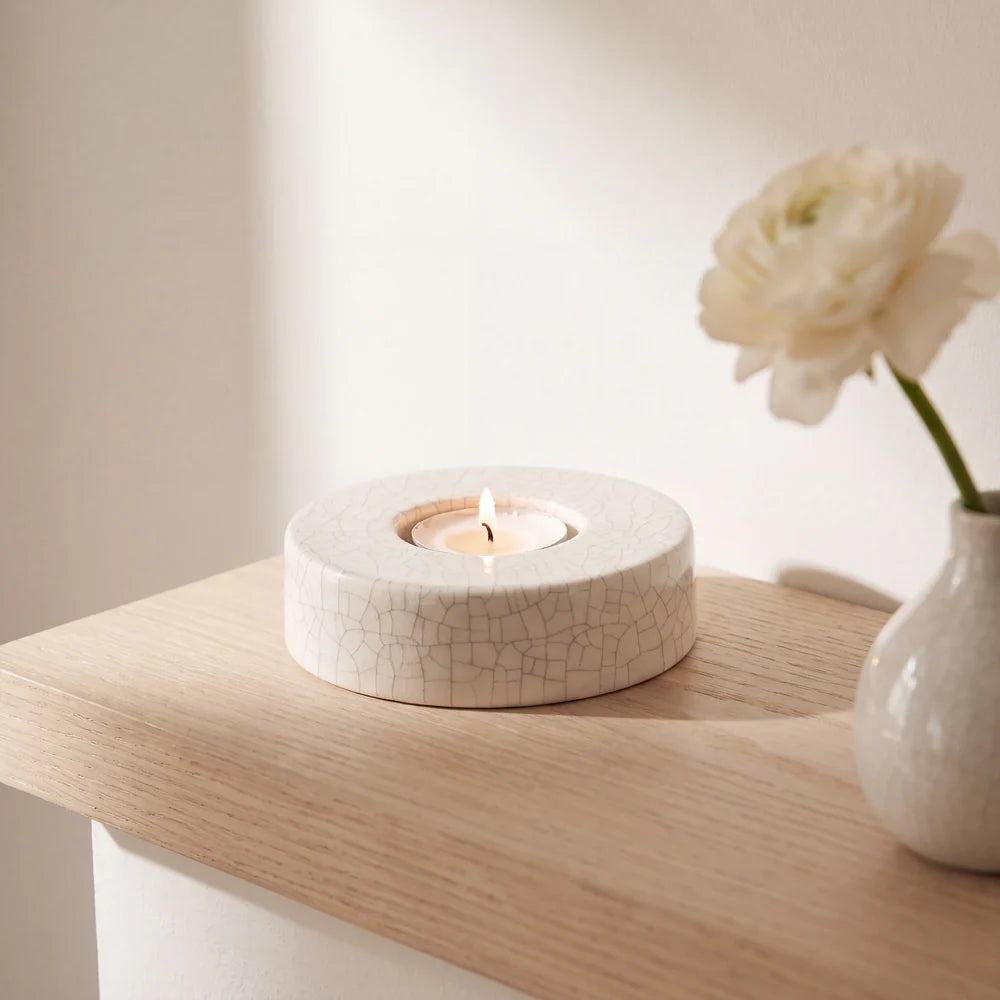
The Caleo Keepsake Candle in Cream is a round ceramic holder for a single tea light, with a smooth cream glaze. Low and shallow, it measures 3 cm high and 11 cm across (1.2 by 4.3 in) and weighs 0.32 kg (0.7 lb). Its page is clear that it is a candle holder only and is not for ashes. A crackle glaze version has fine lines across the glaze, in the same size.

Pictured: Caleo Keepsake Candle in Cream
A Caleo candle holder is the wrong gift for a home where an open flame cannot be left safely, for example with small children or pets at shelf height, and for a family whose faith or custom would make a candle feel out of place. In those cases a card alone, or a donation in the person's name, is the better choice. If you are thinking of a larger gift, or a keepsake that holds ashes, our guide to gifts for a grieving friend explains when to ask the family first. For more on candles in remembrance, see our guide to candle urns for ashes.
When to send a sympathy card, and what if it is late
Send it as soon as you hear, if you can. An early card tells the family straight away that you know and care. A card is not too late after the funeral, though. The weeks afterwards, when the visits and calls slow down, are when a card can mean the most.
If time has passed, just say so: "I am sorry this card is late. I have been thinking of you and of Anne since I heard." The first anniversary, a birthday and the first holidays without the person are also good times to send a few lines.
Sizes and product details in this guide were checked against our product pages on October 21, 2026.
Frequently asked questions
What is a short message to write in a sympathy card?
"I was so sorry to hear about ____. Thinking of you and sending love" is a short sympathy message that fits almost anyone. Using the name of the person who died makes even a single line feel personal.
Should I say "sorry for your loss" in a sympathy card?
You can, but it reads as more personal when you name the person, such as "I am so sorry about your dad." Adding one memory or one quality of the person makes the card mean more.
What should you not write in a sympathy card?
Leave out details of the illness or death, sentences that begin "at least", "I know how you feel", long stories about your own losses, and religious phrases unless you know they fit the family's beliefs.
What do you write on a funeral flower card?
A few words of remembrance and your full name are enough, for example "Forever in our hearts, love from Sarah, Tom and the boys." The card can be written to the person who died or about them.
How do you sign a sympathy card from a couple or a family?
Write both names or the family name after the closing, for example "With deepest sympathy, Ann and Mike Hughes" or "With love, the Patel family", so the family knows exactly who sent it.
Is it too late to send a sympathy card after the funeral?
No. A card that arrives weeks or months later is still welcome, and often arrives when other people have stopped getting in touch. Say that you are sorry it is late and that you have been thinking of them.
Candle Urns for Ashes
See all The Passage Adult Cremation Urn for Ashes in Purple
 Harmony Adult Cremation Urn for Ashes in Glossy Black
 Serenity Adult Cremation Urn for Ashes in Amber Yellow
 Infinity Adult Cremation Urn for Ashes in Crackle Glaze
Written by Urns For Angels
Looking for an urn?
Browse the full range, or ask us and we will help you find the right one.


Leave a comment
This site is protected by hCaptcha and the hCaptcha Privacy Policy and Terms of Service apply.