
Why Choose a Biodegradable Urn? Water and Earth Options
Quick answer: Why choose a biodegradable urn? Because the ashes are going to be buried in the ground or placed on water, and you would like the container to break down naturally and leave nothing behind. It is the right choice for a farewell in nature, and the wrong one if you want to keep the ashes at home for good.
Most urns are made to last. A biodegradable urn is made to do the opposite: to hold the ashes safely for the ceremony, then return to the earth or the water with them. This guide explains what makes an urn biodegradable, the two main kinds, who they suit and who they do not, and shows some of the biodegradable urns we have at the moment.
What makes an urn biodegradable?
An urn is biodegradable when everything it is made of breaks down naturally: the body, the lid, the finish and the bag inside. The urns in this guide are made from mulberry tree bark, plant-based material, bamboo and rock salt. None of them needs glue to close, and each one has a certificate of biodegradability that you can view on its page.
The material decides where the urn can be used. Some are made for water and some for the ground, and the two are not interchangeable. Our guide to what biodegradable urns are made of looks at the materials one by one.
Reasons families choose one
- Nothing is left behind. The urn breaks down along with the ashes, so no metal, plastic or glazed ceramic stays in the soil or the water.
- It suits the place. A container that decomposes belongs in a woodland, a garden or the sea in a way that metal and plastic do not. A biodegradable urn is made for exactly that.
- It gives the ceremony a shape. Lowering an urn into the ground or setting it on the water gives everyone a single moment to share, which some families find gentler than scattering loose ashes on a windy day.
- It reflects the person. For someone who loved the sea, a garden or the outdoors, or who cared about what they left behind, it can simply feel right.
Biodegradable urns for water
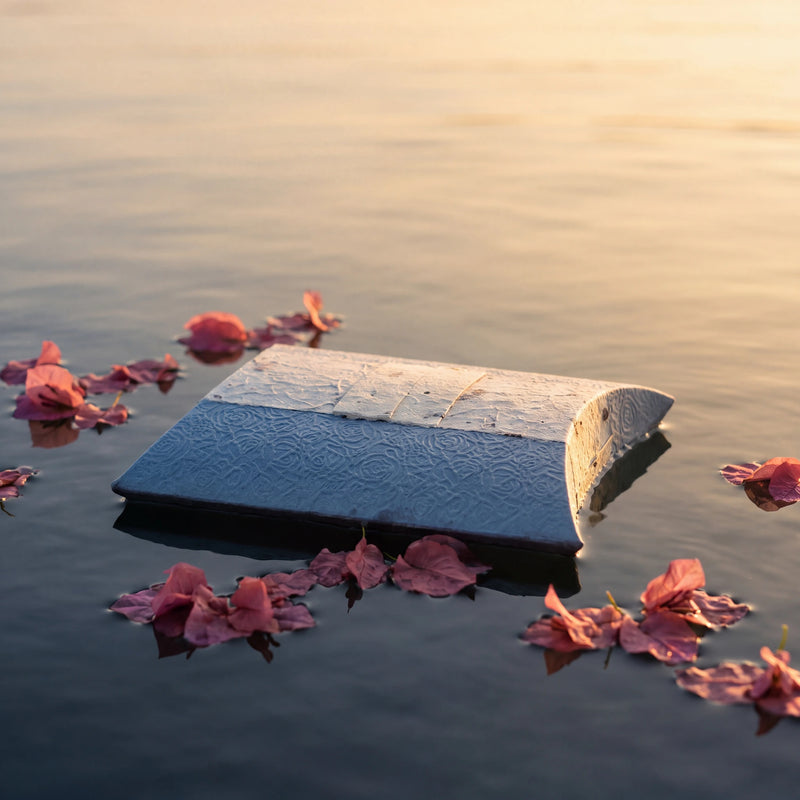
A water urn is placed on the surface, where it floats for a short time, takes on water and sinks, then breaks down. The ashes stay together as they go, and the family can watch from a boat or the shore.
The Journey Biodegradable Water Urn in Aqua is a wide, flat design, shaped rather like a pillow, made from plant-based material. It holds 3.61 liters (about 220 cubic inches), listed as suitable for an adult up to approximately 99 kg (218 lb), and weighs only 0.23 kg (0.5 lb) empty. The ashes go into the biodegradable bag supplied, and the lid closes without glue.

Pictured: Journey Biodegradable Water Urn for Ashes in Aqua - Adult
The Himalayan Rock Salt Biodegradable Water Urn is quite different. It is carved by hand from natural rock salt and left undyed, so each one has its own coloring. It holds 3.31 liters (about 202 cubic inches), listed as suitable for an adult up to approximately 91 kg (200 lb). At 2.42 kg (5.3 lb) empty it is a solid object, and its page says it dissolves fully in water within about four hours. Its page also describes it as suitable for display in the home before use.

Pictured: Himalayan Rock Salt Biodegradable Water Urn for Ashes - Adult
If two people are to be placed on the water together, the Shell Biodegradable Water Urn in Aqua Blue is shaped like a scallop shell and holds 6.55 liters (about 400 cubic inches), enough for two sets of ashes. Our guide to water burial ceremonies describes how the day itself usually goes.

Pictured: Shell Biodegradable Water Urns for Ashes in Aqua Blue
Biodegradable urns for burial in the ground
A burial urn is placed in the soil, where it breaks down over time and the ashes become part of the ground. It is the usual choice for a natural burial ground, a family plot or a memorial garden.
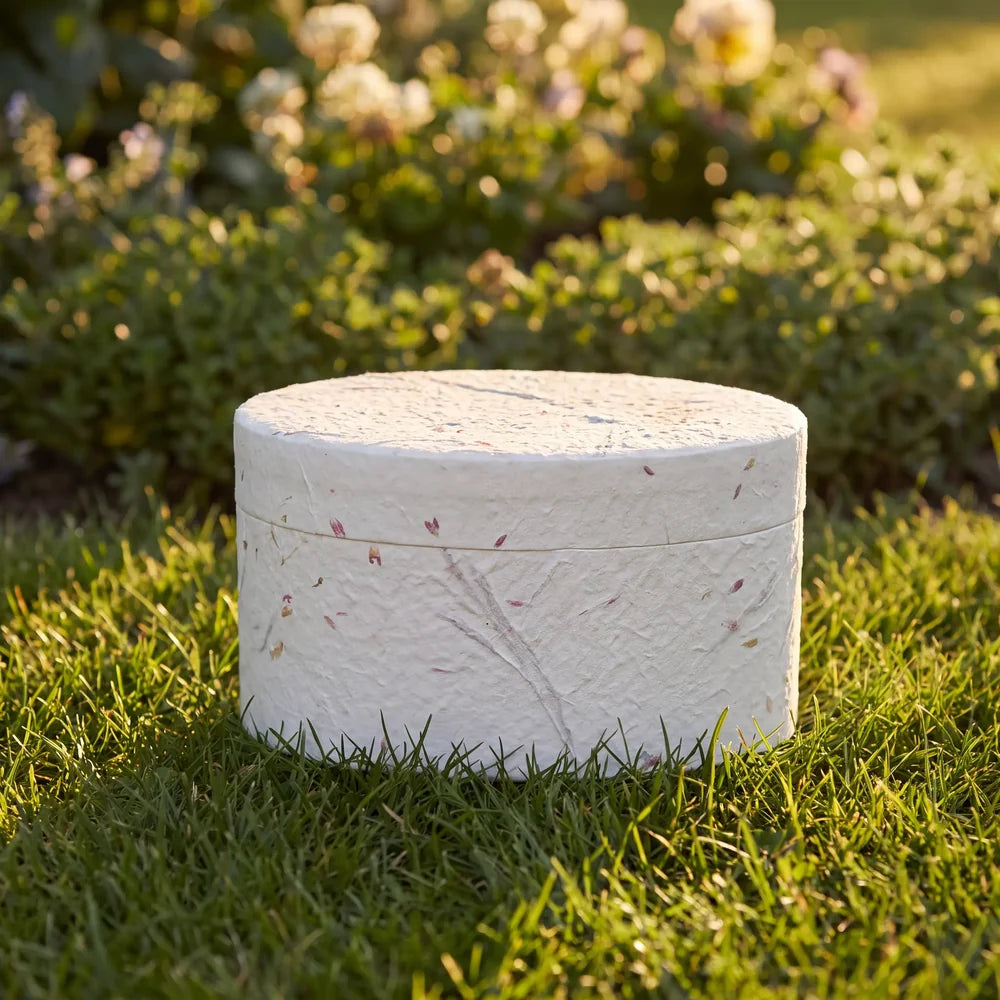
The Simplicity Earthurn in Floral is made by hand from mulberry tree bark, which is harvested without harming the tree. It holds 3.93 liters (about 240 cubic inches), listed as suitable for an adult up to approximately 108 kg (238 lb), and weighs 0.55 kg (1.2 lb) empty. The lid lifts off. A line of non-toxic paper glue around the rim is optional, and the glue is not supplied.

Pictured: Simplicity Earthurn Biodegradable Urn for Ashes in Floral - Adult
The Purity Earthurn in White is made from the same mulberry bark in a plain white finish. It holds 3.44 liters (about 210 cubic inches), listed as suitable for an adult up to approximately 95 kg (209 lb).

Pictured: Purity Earthurn Biodegradable Urn for Ashes in White - Adult
The Eco Burial Bamboo Biodegradable Urn is a plain cylinder made entirely from bamboo, with a removable lid. It holds 3.1 liters (about 189 cubic inches). Bamboo is strong enough for the urn to be kept at home first and buried later, which helps when a family is not ready to choose a date.

Pictured: Eco Burial Bamboo Biodegradable Urn for Ashes - Adult
Cemeteries and natural burial grounds set their own rules about containers and depth, so ask before you choose. Our guide to what type of urn is best for burial covers the questions to ask.
The urns in this guide, side by side
- Journey in Aqua: 3.61 liters (220 cubic inches). Lid closes without glue. For open water.
- Himalayan Rock Salt: 3.31 liters (202 cubic inches). Lid closes without glue. For open water, and for display at home beforehand.
- Shell in Aqua Blue: 6.55 liters (400 cubic inches). Two halves press together. For open water, for two people.
- Simplicity Earthurn in Floral: 3.93 liters (240 cubic inches). Lift-off lid. For burial in the ground.
- Purity Earthurn in White: 3.44 liters (210 cubic inches). Lift-off lid. For burial in the ground.
- Eco Burial Bamboo: 3.1 liters (189 cubic inches). Removable lid. For display at home, then burial in the ground.
If you are unsure about capacity, our urn size guide shows how to work it out.
When a biodegradable urn is not the right choice
A biodegradable urn is not for everyone, and it is better to know that before the day.
- You want to keep the ashes at home permanently. Choose a metal, ceramic or wooden display urn instead. Most biodegradable urns are made for a single ceremony, and water urns in particular must be kept dry until then.
- The ashes are going into a columbarium niche or a lined cemetery vault. Nothing breaks down there, so a permanent urn is the better fit. Ask the cemetery what it accepts.
- You may want to move the ashes later. Once a biodegradable urn has been buried or placed on water, the ashes cannot be recovered. If the family is undecided, wait, or keep a small portion back in a keepsake.
- You would rather scatter. A scattering tube is made for releasing loose ashes by hand, which an urn for water or burial is not.
United States: the federal rule for placing ashes in the ocean
In the United States, the Environmental Protection Agency says that cremated remains may be placed in or on ocean waters of any depth, provided this takes place at least three nautical miles from land, and that the EPA must be notified within 30 days afterward (EPA, Burial at Sea, read on October 8, 2026). The same page says that flowers and wreaths made of materials that are readily decomposable in the marine environment may be placed at the site. A water urn made without plastic is in keeping with that.
The EPA also says its permit covers ocean waters and human remains only. Scattering in lakes, rivers and other inland waters is not regulated under that federal law, though individual states may have their own requirements. This is general information, not legal advice. Rules differ in other countries, so check with the authority responsible for the water or the land you have in mind.
Sizes and product details in this guide were checked against our product pages on October 8, 2026.
Frequently asked questions
Why choose a biodegradable urn?
Choose a biodegradable urn when the ashes will be buried in the ground or placed on water and you want the container to break down naturally with them. It is not the right choice for keeping ashes at home permanently.
What makes an urn biodegradable?
An urn is biodegradable when every part of it breaks down naturally, including the lid, the finish and the bag inside. The urns in this guide are made from mulberry tree bark, plant-based material, bamboo and rock salt.
Can the same biodegradable urn be used for water and for the ground?
Usually not. Water urns are made to float briefly, sink and break down in water, while burial urns are made to break down in soil. Each product page says which use the urn is made for.
Can I keep a biodegradable urn at home before the ceremony?
Some can, as long as they stay dry. The Himalayan Rock Salt urn and the Eco Burial Bamboo urn in this guide are both described on their pages as suitable for display at home before use.
How long does a biodegradable urn take to break down?
It depends on the material and the conditions. The Himalayan Rock Salt urn is listed as dissolving fully in water within about four hours, and our guide to how long biodegradable urns last explains the rest.
Do I need permission to place a biodegradable urn in the sea?
It depends on the country. In the United States, the Environmental Protection Agency requires that it takes place at least three nautical miles from land and that the EPA is notified within 30 days afterward.
Biodegradable Urns for Ashes
See all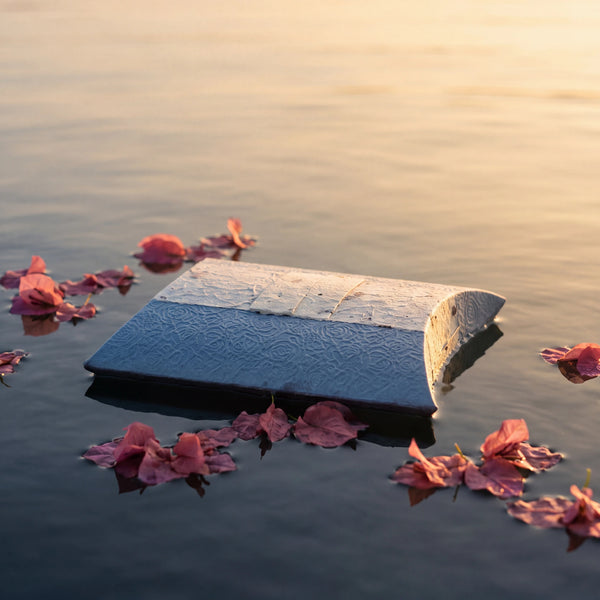 Journey Biodegradable Water Urn for Ashes in Aqua Blossom - Adult
 Embrace Biodegradable Urn for Ashes in White Hemp - Adult
 Pillow Biodegradable Natural Fibre Paper Water Urn for Ashes - Adult
 Simplicity Earthurn Biodegradable Urn for Ashes in Floral - Adult
Written by Urns For Angels
Looking for an urn?
Browse the full range, or ask us and we will help you find the right one.
Keep reading
-
9 min read
Why Choose a Ceramic Cremation Urn? Benefits and Limits
-
11 min read
Why Choose a Metal Urn? Metals, Finishes and Who It Suits
-
10 min read
Porcelain Urns for Ashes: What They Are and Who They Suit
See every guide on Choosing an Urn: Types, Materials and Sizes


Leave a comment
This site is protected by hCaptcha and the hCaptcha Privacy Policy and Terms of Service apply.