


Human Composting and Other Alternatives to Cremation
Quick answer: Human composting, also called natural organic reduction or terramation, turns a body into soil inside a closed vessel filled with plant material such as wood chips, alfalfa and straw. In the United States it was legal in 13 states as of May 30, 2025, according to the National Funeral Directors Association (read October 22, 2026). In England and Wales no new funerary method is in use yet, according to the Law Commission's report summary of June 4, 2026.
Human composting is one of a small group of alternatives to flame cremation. The others most often asked about are water cremation, natural burial and burial at sea. This guide explains what each one is, what the family receives afterwards and where each is allowed today, starting with human composting because it is the one people search for most. Every rule and figure below carries a link to the official body or trade body it comes from, with the date we read it.
This is general information, not legal advice. The law differs between countries and between US states, and it is changing quickly, so a local funeral director or the regulator named in each section is the place to confirm what is available where you live.
Key facts about human composting
- The National Funeral Directors Association (NFDA) defines natural organic reduction as "the contained, accelerated conversion of human remains to soil" (NFDA, read October 22, 2026).
- NFDA lists 13 states where it is legal as of May 30, 2025: Arizona, California, Colorado, Delaware, Georgia, Maine, Maryland, Minnesota, Nevada, New York, Oregon, Vermont and Washington (NFDA, read October 22, 2026).
- Washington's law, the earliest on NFDA's list, took effect on May 1, 2020 (Washington State Legislature, final bill report on ESSB 5001, read October 22, 2026).
- The Cremation Association of North America (CANA) says the process "results in approximately 1 cubic yard of compost" (CANA, read October 22, 2026).
- Sources differ on how long it takes: the NFDA says about four to six weeks, while CANA says it "may take two to six months depending on equipment and body mass" (both read October 22, 2026).
- In England and Wales, "there are no new funerary methods in use", and the Law Commission recommended a new legal framework on June 4, 2026 (Law Commission report summary, read October 22, 2026).
- In 2023 the Committee on Doctrine of the US Conference of Catholic Bishops concluded that alkaline hydrolysis and human composting "fail to meet" the Church's criterion of due respect for the body (USCCB, March 20, 2023, read October 22, 2026).
What is human composting?
Human composting is a way of returning a body to the earth in weeks or months instead of years. People also call it body compost, natural organic reduction (NOR) or terramation. The Law Commission of England and Wales describes it plainly in its report summary of June 4, 2026: "the body of a deceased person is placed in a sealed chamber, or vessel, with organic matter that enables quicker decomposition than in burial."
The NFDA (read October 22, 2026) names the plant material as "wood chips, straw and alfalfa". Microbes then do the work. Over several weeks, in NFDA's words, "microbial activity breaks down the body, transforming it into nutrient-rich soil."
Heat is part of the process. CANA (read October 22, 2026) says the vessel's contents "will be monitored to ensure they reach a minimum of 131 degrees Fahrenheit for at least 72 consecutive hours to destroy all pathogens." That is 55 degrees Celsius by our conversion. CANA's Board of Directors took the position in 2022 that natural organic reduction "is a unique form of disposition", not a type of cremation.
How long it takes
Here the two US trade bodies give different figures, so we give both. The NFDA says about four to six weeks. CANA says the process "may take two to six months depending on equipment and body mass". Both pages were read on October 22, 2026. A provider can tell you what its own equipment takes.
What the family receives
There are no ashes after human composting. What comes back is soil, and a good deal of it. CANA (read October 22, 2026) says the process "results in approximately 1 cubic yard of compost", which is about 0.76 cubic meters by our conversion. The US Conference of Catholic Bishops gives the same amount, "approximately a cubic yard", in its 2023 statement.
That is far more than will fit in any urn. CANA says the compost "is often available for families to take with them or to be used in natural settings." Rules on where the soil may go can differ from state to state, so ask the provider before planning to use it.
Where human composting is legal
United States
Each state decides. The NFDA (read October 22, 2026) lists these states, with the year each acted, as of May 30, 2025: Arizona (2024), California (approved in 2022, effective in 2027), Colorado (2021), Delaware (2024), Georgia (2025), Maine (2024), Maryland (2024), Minnesota (2025), Nevada (2024), New York (2024), Oregon (2022), Vermont (2023) and Washington (2020).
Washington came first on that list. The final bill report on ESSB 5001 from the Washington State Legislature (read October 22, 2026) gives the same definition NFDA uses and an effective date of May 1, 2020. Under that law, a license or endorsement is required "to operate or conduct natural organic reduction, or operate a natural organic reduction facility."
The lists do not all agree. CANA's own page (read October 22, 2026) still says "there are now eight states where natural organic reduction is legal" and shows no date for that count, so NFDA's dated list is the more recent of the two. We list only the states on NFDA's dated list, because we could not confirm any other state from an official source on October 22, 2026. Legal does not always mean a provider is open near you, and states keep changing their laws, so a funeral home in your state is the best place to check.
England and Wales
In England and Wales, no new funerary method is in use yet, and that includes human composting. The Law Commission's project page (read October 22, 2026) says new funerary methods "are not currently regulated, other than by laws which apply more generally such as environmental and planning law", and that using them "may be prohibited by the law on death registration, but the position is unclear."
The Law Commission published its final report on June 4, 2026, with one draft Bill for England and one for Wales. It recommends a power for the Secretary of State (for England) and the Welsh Ministers (for Wales) "to make regulations about individual new funerary methods", and that any method not regulated, or not part of an approved trial, "should be prohibited". The report does not decide whether human composting should be allowed. The report summary says that "will be a question for the UK Government and the Welsh Government respectively."
Scotland
Scotland has made rules for water cremation but not, as far as we could find, for human composting. The Hydrolysis (Scotland) (No. 2) Regulations 2026 came into force on March 2, 2026 (legislation.gov.uk, read October 22, 2026), and they deal with hydrolysis. We found no Scottish Government source, as of October 22, 2026, that regulates human composting, so a funeral director in Scotland is the person to ask.
Northern Ireland
We did not find an official source on human composting in Northern Ireland, so we have left it out.
Other alternatives to flame cremation
Water cremation (alkaline hydrolysis)
Water cremation uses water, alkaline chemicals and heat in place of flame. Unlike human composting, it leaves bone, which is dried and returned to the family much like ashes. The Cremation Association of North America (read October 22, 2026) says it is legal in 26 US states "as of March 2026", and that it "results in approximately 32% more cremated remains than flame-based cremation and may require a larger urn." In Scotland the Hydrolysis (Scotland) (No. 2) Regulations 2026 came into force on March 2, 2026 (legislation.gov.uk, read October 22, 2026). Our guide to water cremation explains how it works and where it is legal.
Natural or green burial
Natural burial is the oldest option here, and it is a burial, not a new process. The US Green Burial Council (read October 22, 2026) describes it as "a more natural, environmentally-conscious approach to death care" that "prioritizes placing the body directly in the Earth, forgoing embalming, and using biodegradable materials." The council notes that state laws and regulations vary. Ashes from a flame cremation can also be buried, in a biodegradable urn.
England: burial at sea
A body can be buried at sea in some places. "A marine licence is required from the Marine Management Organisation (MMO) for a burial at sea in English waters or Northern Irish offshore waters", according to GOV.UK (last updated March 25, 2026, read October 22, 2026). The page names three designated sites: off The Needles on the Isle of Wight, between Hastings and Newhaven, and off Tynemouth in North Tyneside. "The body of the deceased must not be embalmed." For ashes the rule is different: "You don't need a licence or permission to scatter ashes at sea after a cremation." Our guide to the laws on scattering ashes has more on that.
The options side by side
- Human composting: about 1 cubic yard (0.76 cubic meters) of soil returned (CANA, read October 22, 2026); 13 US states on the NFDA list as of May 30, 2025; not in use in England and Wales (Law Commission, June 4, 2026).
- Water cremation: dried bone returned like ashes, approximately 32% more than a flame cremation, and 26 US states as of March 2026 (CANA, read October 22, 2026); Scottish regulations in force since March 2, 2026 (SSI 2026/51).
- Natural burial: the body is buried without embalming in biodegradable materials; nothing is returned (Green Burial Council, read October 22, 2026).
- Burial at sea (England): the body is buried at one of three designated sites; nothing is returned; a marine licence is required (GOV.UK, last updated March 25, 2026).
- Flame cremation: ashes returned; available across the UK and US.
Faith and personal views
Not every faith accepts the newer methods. The Committee on Doctrine of the United States Conference of Catholic Bishops, in On the Proper Disposition of Bodily Remains (March 20, 2023), says alkaline hydrolysis and human composting "fail to meet" the Church's criterion. On composting, it writes that "there is nothing left but compost, nothing that one can point to and identify as remains of the body." Other faiths and denominations hold their own views, so it may help to speak to your own minister, priest or faith leader.
Who human composting suits, and who it may not
This option may suit someone who wanted their body to go back into the ground, who cared about the land, or who liked the idea of soil being used to grow something. A family who want a grave or an urn to visit may find it wrong for them, because nothing like ashes is returned. So may those whose faith does not accept it. In England, Wales and the states without a law, no provider offers it yet, though a provider in another state may be an option. In those cases a flame cremation, water cremation or natural burial may come closer to the wish. Our guide to traditional and direct cremation explains the most common choice.
Recording a wish for a green farewell
If the person wanted a gentle return to the earth but human composting is not available where you are, a cremation followed by burial in a biodegradable urn is one way to come close. Our biodegradable burial urns are made to break down once buried. Writing the wish down, and telling the family, saves guessing later.
The Simplicity Earthurn Biodegradable Urn in Slate Grey, Adult is made by hand from mulberry tree bark in a cool stone-gray finish, with a lift-off lid. Its page gives a capacity of 3.93 liters (about 240 cubic inches), suitable for an adult of up to approximately 108 kg (238 lb) in pre-cremation body weight. Simplicity stands 25.4 cm (10.0 in) high and weighs 0.55 kg (1.2 lb) empty.

Pictured: Simplicity Earthurn Biodegradable Urn for Ashes in Slate Grey - Adult
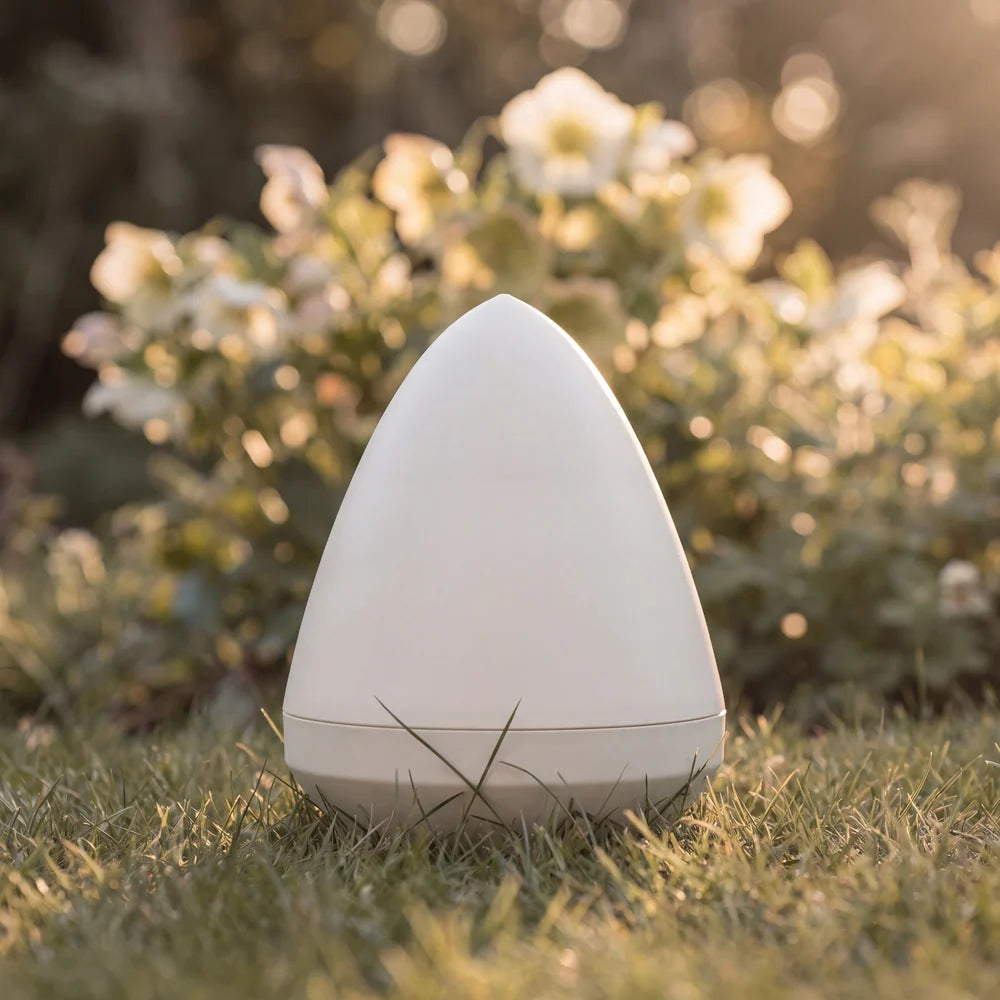
A paler choice is the Celeste Biodegradable Urn in Ivory, an ivory urn that rises to a rounded point, also made by hand from mulberry bark. Its page gives 3.54 liters (about 216 cubic inches), suitable for an adult of up to approximately 97 kg (213 lb). Celeste is 25.0 cm (9.8 in) high and weighs 0.7 kg (1.5 lb) empty. Both are made to be buried and to break down in the ground. After a water cremation, CANA's figure of approximately 32% more remains means the usual weight guide may not apply, so go by the amount the provider tells you. Our guide on why families choose a biodegradable urn goes into more detail.
Sources
- National Funeral Directors Association, "Natural Organic Reduction" (human composting), nfda.org. State list dated May 30, 2025. Read October 22, 2026.
- Cremation Association of North America, "Natural Organic Reduction", cremationassociation.org/nor.html. Read October 22, 2026.
- Cremation Association of North America, "Alkaline Hydrolysis", cremationassociation.org/AlkalineHydrolysis. State list dated March 2026. Read October 22, 2026.
- Washington State Legislature, final bill report, ESSB 5001 (2019-20), "Concerning human remains", leg.wa.gov. Read October 22, 2026.
- Law Commission of England and Wales, "New funerary methods" project page, lawcom.gov.uk. Read October 22, 2026.
- Law Commission of England and Wales, "New Funerary Methods: Summary of the Report", June 2026, report summary (PDF). Read October 22, 2026.
- The Hydrolysis (Scotland) (No. 2) Regulations 2026, Scottish Statutory Instruments 2026 No. 51, legislation.gov.uk. Read October 22, 2026.
- GOV.UK, "How to arrange a burial at sea in the UK marine area", last updated March 25, 2026, gov.uk. Read October 22, 2026.
- Green Burial Council, "What Is Green Burial", greenburialcouncil.org. Read October 22, 2026.
- United States Conference of Catholic Bishops, Committee on Doctrine, "On the Proper Disposition of Bodily Remains", March 20, 2023, usccb.org (PDF). Read October 22, 2026.
Sizes and product details in this guide were checked against our product pages on October 22, 2026.
Frequently asked questions
What is human composting?
Human composting, also called natural organic reduction or terramation, places a body in a closed vessel with plant material such as wood chips, straw and alfalfa, where microbes turn it into soil. The National Funeral Directors Association (read October 22, 2026) defines it as "the contained, accelerated conversion of human remains to soil."
How long does human composting take?
The sources differ. The NFDA says about four to six weeks, and the Cremation Association of North America says two to six months depending on equipment and body mass (both read October 22, 2026).
How much soil does body compost make?
The Cremation Association of North America (read October 22, 2026) says the process results in approximately 1 cubic yard of compost, which is about 0.76 cubic meters.
Which states allow human composting?
The NFDA lists 13 states as of May 30, 2025: Arizona, California (effective in 2027), Colorado, Delaware, Georgia, Maine, Maryland, Minnesota, Nevada, New York, Oregon, Vermont and Washington. Laws are changing, so check with a funeral home in your state.
Is human composting legal in the UK?
It is not in use in England and Wales. The Law Commission recommended a new legal framework for new funerary methods on June 4, 2026, and left the choice of which methods to allow to the UK and Welsh Governments (report summary). We found no official rules for human composting in Scotland or Northern Ireland as of October 22, 2026.
Is human composting the same as water cremation?
No. Human composting turns the body into soil using plant material and microbes, while water cremation uses water, alkaline chemicals and heat and leaves bone that is returned like ashes. The Cremation Association of North America (read October 22, 2026) says its Board took the position in 2022 that natural organic reduction "is a unique form of disposition, not a type of cremation or alkaline hydrolysis."
Biodegradable Burial Urns
See all Embrace Biodegradable Urn for Ashes in White Hemp - Adult
 Simplicity Earthurn Biodegradable Urn for Ashes in Floral - Adult
 Loop EarthRise™ Biodegradable Urn for Ashes - Adult
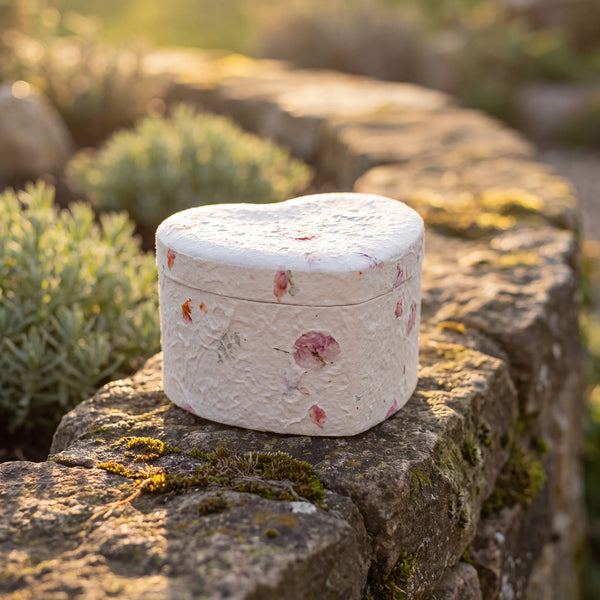 Love Heart Biodegradable Urn for Ashes in Floral - Adult
Written by Urns For Angels
Looking for an urn?
Browse the full range, or ask us and we will help you find the right one.
Keep reading
-
8 min read
Is There Energy in Cremation Ashes?
-

18 min read
The Cremation Process: Step by Step in the UK and US
-
16 min read
Direct Cremation vs Traditional Cremation: A Comparison
See every guide on Cremation Explained: Process, Costs and Rules


Leave a comment
This site is protected by hCaptcha and the hCaptcha Privacy Policy and Terms of Service apply.