
Scattering Ashes at Sea in the UK: Rules and How to Do It
Enter the code at checkout.
Everything was straight forward. Speedy service. Good communication.
Excellent customer service and website ordering process easy to use. When i rang they were extremely helpful and professional sending me the details i needed while i was on the call.
Paul was very helpful and kind.
Scatter Tubes for Ashes
 Eco Bamboo Biodegradable Scattering Urn for Ashes – Adult
$158.00
 Wildflower Adult Biodegradable Scattering Urn
$113.00
- ★ 5.0
 Rainbow River Eco Friendly Scattering Tube for Ashes - Adult
$94.00
 Natural Fibre Small Biodegradable Scattering Urn
$85.00
 Autumn Woods Eco Friendly Scattering Tube for Ashes - Adult
$94.00
 Paws to Paradise Eco Friendly Scattering Tube for Pet Ashes - Small
$79.00
 Wild Horses Eco Friendly Scattering Tube for Ashes - Mini
$70.00
 Silver Lining Eco Friendly Scattering Tube for Ashes - Medium
$80.00
 Silver Lining Eco Friendly Scattering Tube for Ashes - Mini
$70.00
 Silver Lining Eco Friendly Scattering Tube for Ashes - Token
$68.00


Biodegradable Urns for Water Burial
- ★ 5.0
 Journey Biodegradable Water Urn for Ashes in Aqua Blossom - Adult
$154.00
 Himalayan Rock Salt Biodegradable Water Urn for Ashes - Adult
$302.00
- ★ 5.0
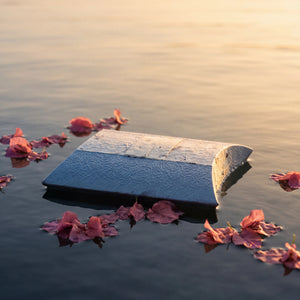
 Pillow Biodegradable Floral Paper Water Urn for Ashes - Adult
$137.00
- ★ 4.7
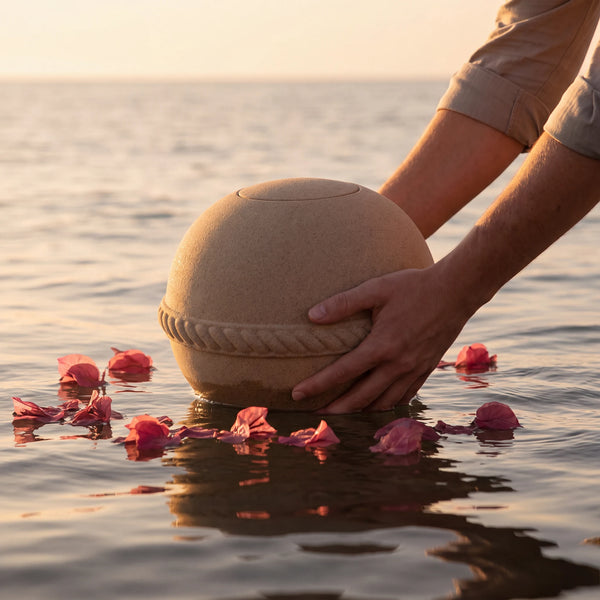 Oceane Round Sand Biodegradable Water Urn for Ashes - Adult
$233.00
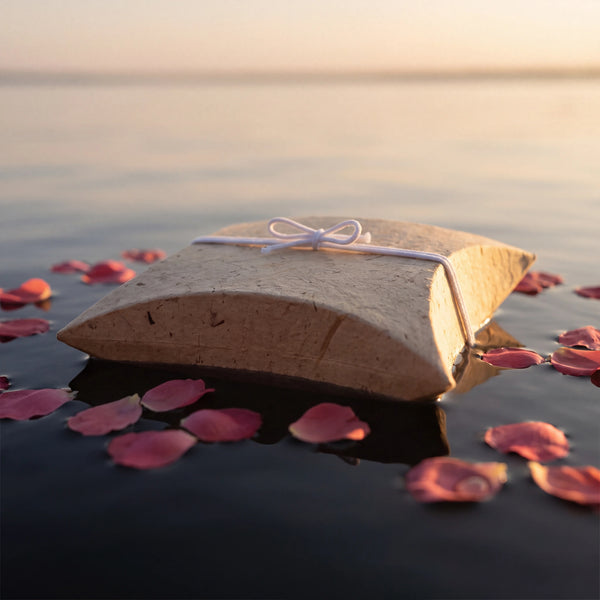 Pillow Biodegradable Natural Fibre Paper Water Urn for Ashes - Adult
$137.00
- ★ 4.7
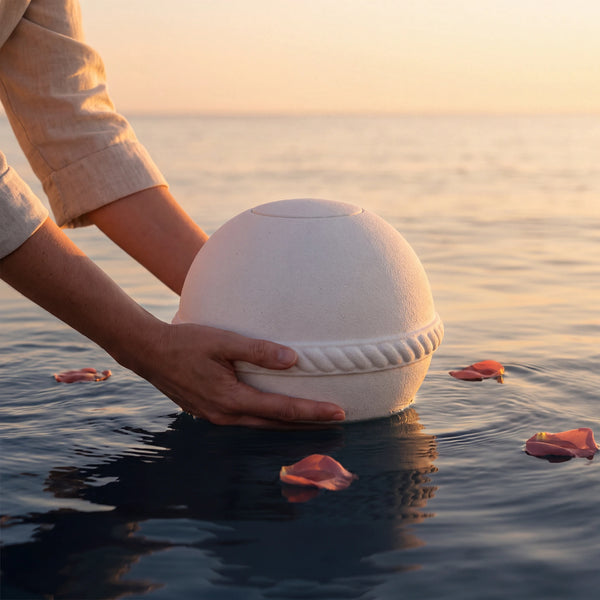 Oceane Round Quartz Biodegradable Water Urn for Ashes - Adult
$233.00
 Dome Biodegradable Urn for Ashes – Medium
$244.00
- ★ 5.0
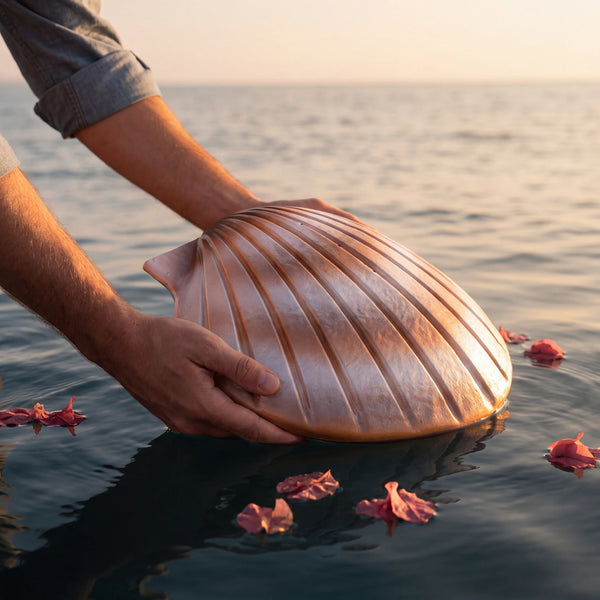 Shell Biodegradable Water Urn for Ashes in Pearl
$411.00
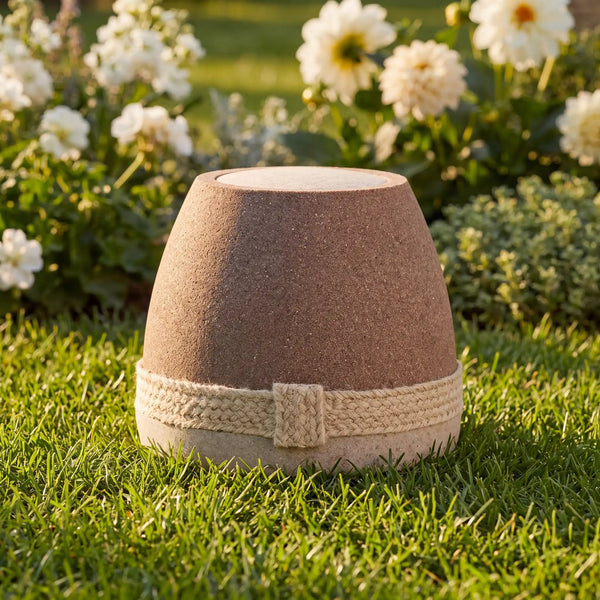 Dome Samsara Biodegradable Urn for Ashes – Medium
$244.00
 Nu Water Biodegradable Urn for Ashes – Adult
$263.00


Jump to a section of this guideShow sectionsHide
Quick answer: In English waters, the Marine Management Organisation says: "You don't need a licence or permission to scatter ashes at sea after a cremation." A burial at sea, where a body is committed to the sea in a weighted coffin, is different: it needs a marine license, and the MMO page sets out the exceptions and the other UK bodies to contact. On a beach, ask whoever manages it first, then choose a calm day, check the tide and let the ashes go low and downwind.
Scattering ashes at sea is one of the simplest farewells to arrange in the UK. There is no form to fill in for loose ashes, and you can do it from a beach, a harbor wall, a cliff path or a boat. What takes thought is the day itself: the wind, the tide, who comes and what you carry the ashes in. This guide covers the rules first, then the practical side, with a few pieces from our scatter tubes for ashes and water urns that are made for the coast.
If you are thinking of placing a whole urn in the water rather than scattering, our guide to water burial ceremonies explains how those urns float and sink, so it is not repeated here.
UK rules for scattering ashes at sea
This is general information, not legal advice. The rule comes from the Marine Management Organisation (MMO), which handles marine licenses in English waters. Its guidance says, in its own words: "You don't need a licence or permission to scatter ashes at sea after a cremation." (Marine Management Organisation, How to arrange a burial at sea in the UK marine area, last updated March 25, 2026, read November 20, 2026.)
That sentence is about scattering. Two things are worth knowing beside it:
- The MMO page deals with English waters and Northern Irish offshore waters. For burials at sea in Welsh, Scottish and inshore Northern Irish waters, it names other bodies to contact (Natural Resources Wales, the Burial, Cremation and Death Certification Team for Scotland, and the Department of Agriculture, Environment and Rural Affairs for Northern Ireland), under "Burials at sea elsewhere in the UK marine area" on the same page. It does not name bodies for scattering in those waters.
- Local rules can still apply where you stand. A harbor, a marina, a nature reserve or a private beach may have its own conditions, so check with whoever runs the place.
For scattering on land, in rivers, on lakes or on someone else's land, our guide to the laws and permissions for scattering ashes goes through each place in turn.
Burial at sea in the UK: how it differs
People often search for "burial at sea" when they mean scattering ashes, so the difference matters. The MMO guidance defines it in its own words: "A burial at sea is the process in which human remains are committed to the sea as a final resting place." The conditions of the license then require a weighted softwood coffin. The MMO also says: "A marine licence is required from the Marine Management Organisation (MMO) for a burial at sea in English waters or Northern Irish offshore waters." (MMO, read November 20, 2026.)
The same page sets out what that involves:
- Where: "There are three designated burial at sea locations, which are: off The Needles, Isle of Wight; between Hastings and Newhaven; off Tynemouth, North Tyneside." The page explains that a self-service license covers only these sites and is quicker; other sites need a standard license.
- Paperwork: before applying you need documents including a death certificate and "a Certificate of Freedom from Fever and Infection".
- The coffin: "The coffin must be constructed of solid softwood (not veneered board or solid hardwood)." It must also be weighted, and the page gives the full specification.
There are other conditions and exceptions, so read the whole MMO page, or ask a funeral director who arranges sea burials. If cremation has already taken place, none of this applies to scattering the ashes.
Scattering ashes on a beach
A beach is often where people want to be: a place the person walked, swam or took the children. The MMO's line covers the sea itself. The beach you stand on belongs to someone, so ask whoever manages it, often the local council, before you go.
A few things make a beach scattering go well:
- Go at low tide or on a falling tide. Scatter at the water's edge, or in the shallows, and the next tide carries the ashes out. Ashes scattered on dry sand above the tide line stay visible for longer. Tide tables for UK ports are easy to find online.
- Pick a quiet time. Early morning or a weekday out of season gives you space, and nobody nearby to worry about.
- Stand with the wind at your back. The finer dust in ashes drifts on even a light breeze. Hold the container low and close to the water, and tip it slowly.
Some families draw a heart or the person's name in the wet sand and scatter the ashes into it, then let the sea take it. Others press a few loose flower petals into the sand. Leave nothing behind that will not wash away: no plastic, no balloons, no wreaths with wire.
Scattering ashes from a boat
A boat can take you to a particular bay, a fishing ground or out past a headland. Ask local boat operators or your funeral director whether they know of a skipper who takes families out for this. Talk to the skipper before the day about how many people the boat takes and where on deck you will stand.
The main thing to remember: scatter from the side of the boat facing away from the wind. Ask the skipper to slow or stop the boat and turn it so that side is clear. Hold the container below the rail, close to the water, and pour slowly. If a family member feels unsteady, they can hold the container together with someone else.
If you are still choosing a place, our guide to the best places for water burials compares the open sea, the shoreline, rivers and lakes.
What to carry the ashes in
The ashes come back from the crematorium in a plastic or card container. It is fine to scatter straight from it, but the opening is often wide and the pour is hard to control in a breeze. A scatter tube is made for this: slim, light to carry down a cliff path and with an opening that lets the ashes out in a steady stream.
The Ascending Dove Eco Friendly Scattering Tube for Ashes, Adult holds 3.93 liters (about 240 cubic inches), the full remains of one adult. Made from recycled paper with no metal or plastic parts, it has a sky-blue print with a dove in flight. A perforated push-in tab opens for a controlled release. It stands 36.8 cm (14.5 in) tall and weighs 0.39 kg (0.9 lb) empty.
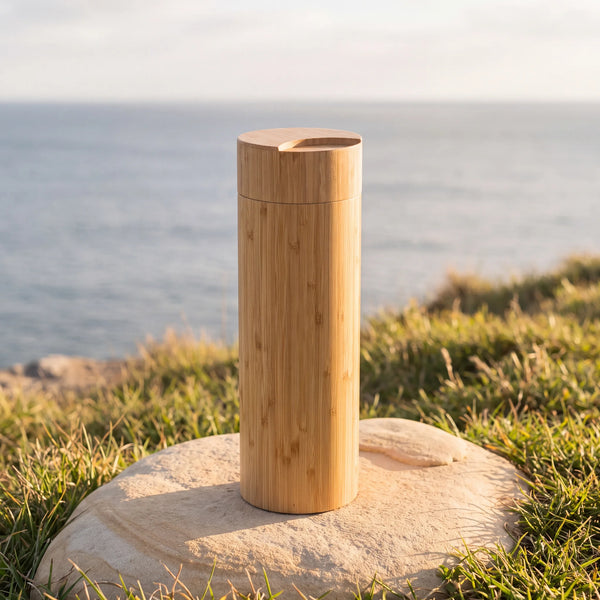
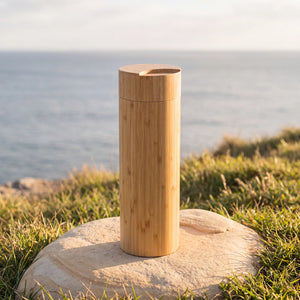
For a longer walk to the spot, or more than one scattering place, the Eco Bamboo Biodegradable Scattering Urn for Ashes, Adult is made from bamboo with a locking pin. That pin keeps the lid shut on the way and lets the ashes out a little at a time, so part can go into the sea from the beach and part somewhere else. Capacity is 3 liters (about 183 cubic inches), and the urn stands 36 cm (14.2 in) tall and weighs 0.4 kg (0.9 lb) empty.

Pictured: Eco Bamboo Biodegradable Scattering Urn for Ashes - Adult
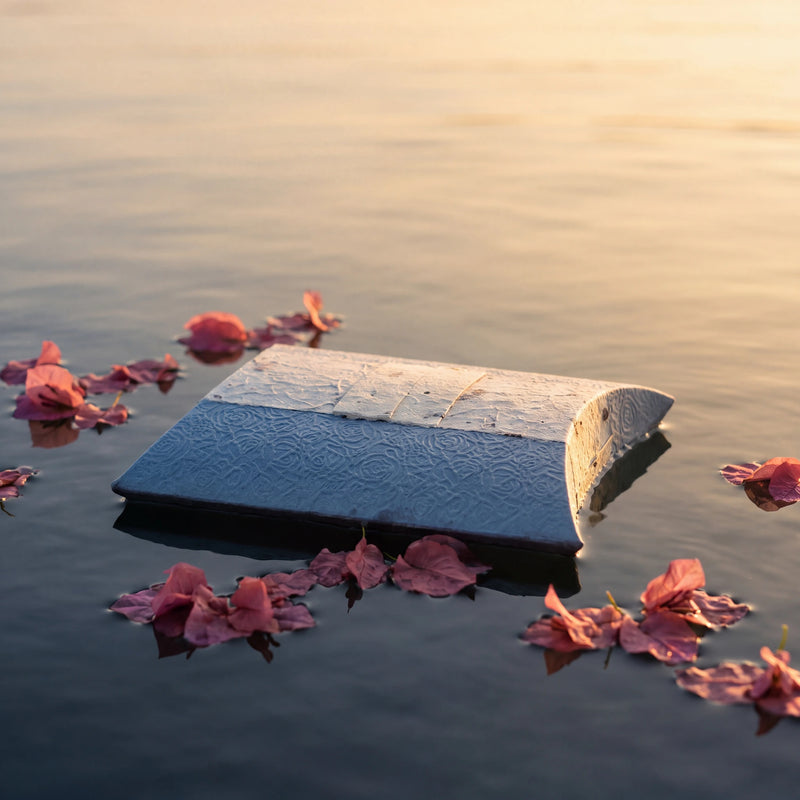
Some families would rather not scatter loose ashes in the wind at all. A water urn is placed on the sea with the ashes inside, then sinks or dissolves. Three from our biodegradable urns for water burial follow: two that can go into the sea from the shore or a boat, and one made for open water.
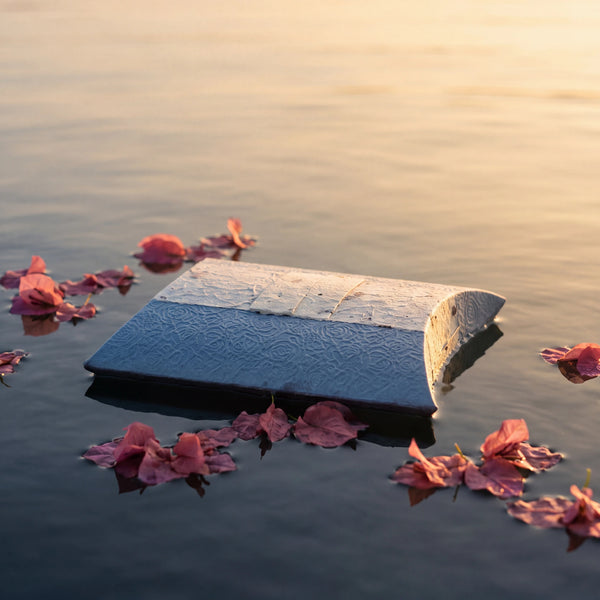
The Oceane Sand Biodegradable Water Urn for Ashes, Adult is finished with real beach sand on its surface. It holds 3.28 liters (about 200 cubic inches), suitable for an adult up to approximately 90 kg (198 lb) in pre-cremation body weight, and stands 22.9 cm (9.0 in) tall. Small holes in the base let water in, so it floats only briefly before sinking.

Pictured: Oceane Sand Biodegradable Water Urn for Ashes - Adult
The Himalayan Rock Salt Biodegradable Water Urn for Ashes, Medium is carved by hand from rock salt and, in the words of its product page, "designed for a farewell on open water", so it suits a boat rather than a beach. The page also says it dissolves fully within about four hours on the water. It holds 1.97 liters (about 120 cubic inches), suitable for an adult up to approximately 54 kg (119 lb), so for a larger adult it suits part of the ashes rather than all of them.

Pictured: Himalayan Rock Salt Biodegradable Water Urn for Ashes - Medium
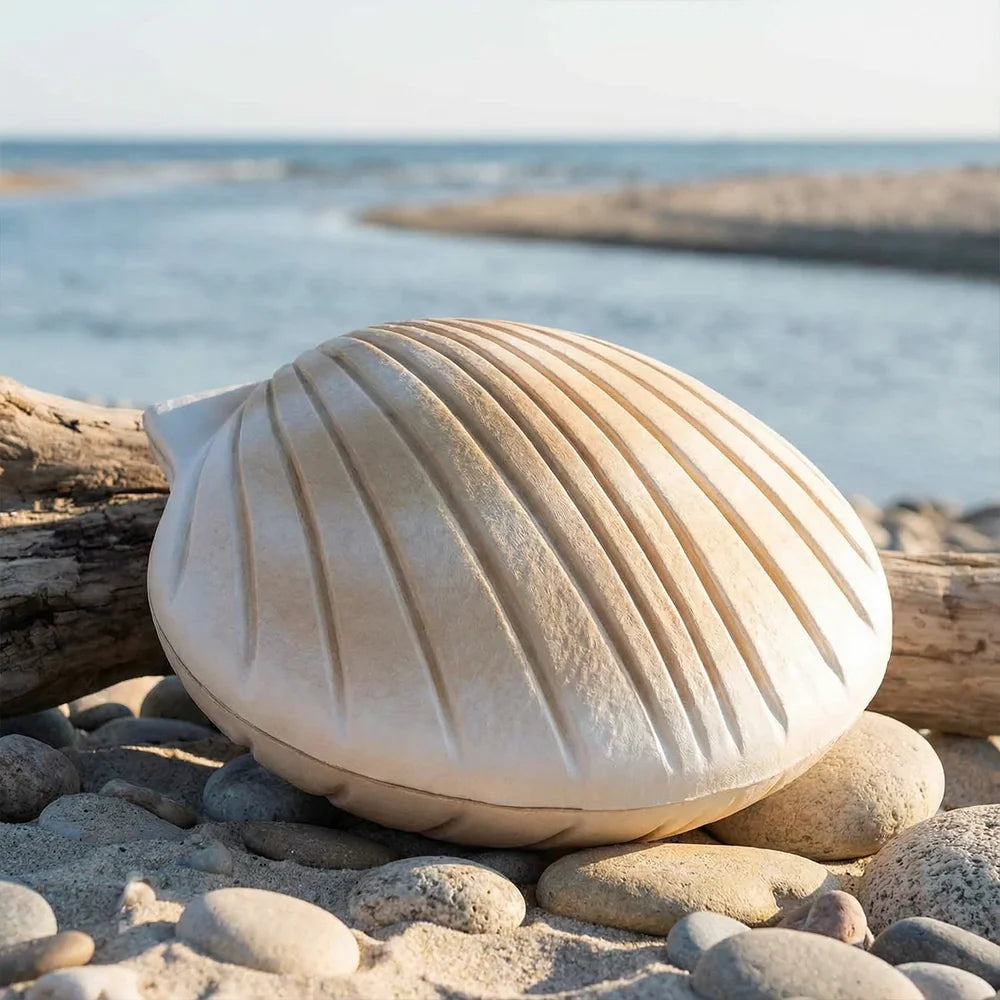
For a couple, or two people who wanted to go into the sea together, the Shell Biodegradable Water Urn for Ashes in Sand is shaped like an open scallop shell and holds two sets of remains: 6.55 liters (about 400 cubic inches) in all. It measures 40.6 cm (16.0 in) wide and 43.2 cm (17.0 in) deep. Placed on the water, it floats for a short while, then sinks. More sea designs are in our ocean urns for ashes.
Side by side:
- Ascending Dove Scattering Tube, Adult: 3.93 L (about 240 cu in), push-in tab, for one steady scattering of loose ashes, held in one hand.
- Eco Bamboo Scattering Urn, Adult: 3 L (about 183 cu in), locking pin, for scattering in stages or in more than one place.
- Oceane Sand Water Urn, Adult: 3.28 L (about 200 cu in), lid closes without glue, placed on the water where it floats briefly then sinks.
- Himalayan Rock Salt Water Urn, Medium: 1.97 L (about 120 cu in), lid closes without glue, placed on open water where it dissolves.
- Shell Water Urn in Sand: 6.55 L (about 400 cu in), two halves pressed together, holds two sets of remains, floats briefly then sinks.
Not sure how much the ashes will fill? Our urn size guide explains how to check.
Who scattering at sea suits, and who it may not
It suits someone who loved the coast, sailing or swimming, and a family who will find it easy to go back to that stretch of shore. For the scattering itself, the MMO says no license or permission is needed.
It is less right if some of the family want a grave or a fixed place to visit, or if not everyone agrees. Scattering cannot be undone. You could keep back a small amount first, in a keepsake urn or a piece of ashes jewellery, so that part of the person stays at home. If you would like ideas for the ceremony itself, our guide on how to scatter ashes has a step-by-step section on using a scatter tube.
Sources
- Marine Management Organisation, How to arrange a burial at sea in the UK marine area, GOV.UK, published November 15, 2017, last updated March 25, 2026, read November 20, 2026.
Sizes and product details in this guide were checked against our product pages on November 20, 2026.
Frequently asked questions
Do you need permission to scatter ashes at sea in the UK?
Not for the scattering itself: the Marine Management Organisation says "You don't need a licence or permission to scatter ashes at sea after a cremation." The person or council who manages the beach, harbor or boat you use may still have their own conditions, so ask them first.
What is the difference between a burial at sea and scattering ashes at sea?
The Marine Management Organisation defines a burial at sea as "the process in which human remains are committed to the sea as a final resting place". Its license conditions require a weighted softwood coffin, and in English waters a burial at sea needs a marine license from the MMO. For scattering ashes after a cremation, the MMO says: "You don't need a licence or permission to scatter ashes at sea after a cremation."
Where can you have a burial at sea in the UK?
In English waters, the Marine Management Organisation lists three designated sites: off The Needles on the Isle of Wight, between Hastings and Newhaven, and off Tynemouth in North Tyneside. Its guidance page explains how to apply for a license at other sites. Burials at sea in Welsh, Scottish and inshore Northern Irish waters are handled by other bodies, which the MMO page names: Natural Resources Wales, the Burial, Cremation and Death Certification Team for Scotland, and the Department of Agriculture, Environment and Rural Affairs for Northern Ireland.
Can you scatter ashes on a beach in the UK?
The MMO guidance covers the sea itself, so for the beach ask whoever manages it, often the local council, before you go. Scatter at the water's edge on a falling tide so the sea carries the ashes away, and pick a quiet time.
How do you stop ashes blowing back when scattering at sea?
Stand with the wind at your back, or on a boat use the side facing away from the wind, hold the container low and close to the water, and pour slowly rather than throwing the ashes.
Can you put flowers in the sea with the ashes?
Loose petals break down, so they are a gentler choice than a wreath. Leave out anything that will not, such as plastic, balloons, ribbon or wreaths made with wire.
Scatter Tubes for Ashes
-
Eco Bamboo Biodegradable Scattering Urn for Ashes – Adult
$158.00
-
Wildflower Adult Biodegradable Scattering Urn
$113.00
- ★ 5.0
Rainbow River Eco Friendly Scattering Tube for Ashes - Adult
$94.00
-
Natural Fibre Small Biodegradable Scattering Urn
$85.00
-
Autumn Woods Eco Friendly Scattering Tube for Ashes - Adult
$94.00
-
Paws to Paradise Eco Friendly Scattering Tube for Pet Ashes - Small
$79.00
-
Wild Horses Eco Friendly Scattering Tube for Ashes - Mini
$70.00
-
Silver Lining Eco Friendly Scattering Tube for Ashes - Medium
$80.00
-
Silver Lining Eco Friendly Scattering Tube for Ashes - Mini
$70.00
-
Silver Lining Eco Friendly Scattering Tube for Ashes - Token
$68.00
Shop the collections in this guide

Written by Urns For Angels
Looking for an urn?
Browse the full range, or ask us and we will help you find the right one.
Keep reading
-
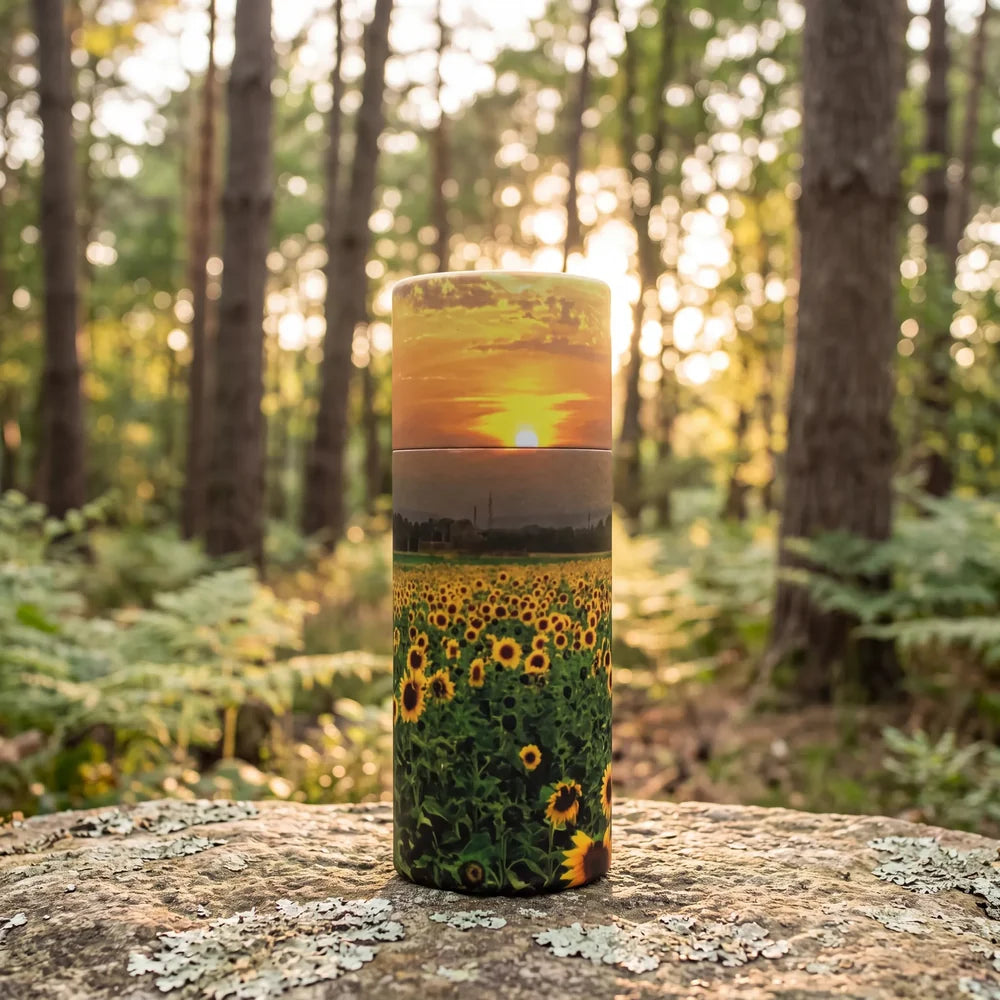
20 min read
Scattering Ashes - The Laws, Regulations, and Permits
-
9 min read
How to Choose a Burial Place for Ashes
-
12 min read
What Is a Water Burial and How Does the Ceremony Work?
See every guide on What to Do With Ashes: Scattering, Burial and Keeping


Leave a comment
This site is protected by hCaptcha and the hCaptcha Privacy Policy and Terms of Service apply.